

When Jurassic Park was released in 1993, it captured the imagination of the entire planet. Audiences saw dinosaurs resurrected on-screen, not just through the magic of cinema, but through seemingly believable biological engineering. After nearly 27 years, part of me still clings to the hope of turning the film into a reality. Could dinosaurs be brought back to life? Could life, uh, find a way?
Dinosaurs have never been strangers to the big screen. Don’t forget, the T-Rex had taken on King Kong back in 1933, Disney made their first dinosaur film, Fantasia, in 1940 and of course The Land Before Time had moved audiences to tears in 1988. These films had existed solely in the fantasy realm, but when Jurassic Park was released in 1993 (based of course on the sensational novel by Michael Crichton), everything changed. It thrust dinosaurs into a whole new world. On top of that, it had everything you need in a film: action, suspense, comedy, and a T-Rex eating a man on the toilet. Obviously.
As a child, Jurassic Park was always one of my favourites, and I’d be lying if I said that wasn’t still the case today. Unlike other dinosaur films, this exists within the real world which instantly makes it more relatable. Using biotech engineering, humans recreate dinosaurs for a theme park. The film explores the evolving relationships between humans and these dinosaurs, when inevitably control begins to break down. But its the science that always fascinated me.
But you don’t want to hear about that from me. I’ll hand this over to Mr DNA himself to explain the science behind the Jurassic Park dinosaurs:
The science of Jurassic Park appeared to make so much sense, so why are we still living in a world without dinosaurs? Surely we have the knowledge and technology to bring dinosaurs back today, right?
It was clear from the start I’d set myself up for disappointment.
The Process: Creating Dinosaurs
Theoretically speaking, the science of Jurassic Park checks out. Sadly though, last time I checked there is a significant difference between theory and practice. If we break down what Mr DNA says, it doesn’t take us long to highlight some fundamental problems with their process. Let me explain.
- The Mosquito in the Amber – What if the mosquito has bitten multiple animals before landing in the tree? Those scientists could be dealing with Double-Dino-DNA at the very least.
- Recreating the Genetic Structure – Dinosaurs have been extinct for 65 million years, yes? Humans are yet to make their first million. Our species have never seen a dinosaur before, so how would we know when we got it right? How can you recreate something when you haven’t seen it before. Through trial and error, there is a faint possibility dinosaurs could be created, but again, how would we know? If our mosquito friend had bitten three dinosaurs, would we realise when we had created a new hybrid dinosaur from the blood? How could the DNA be separated, when we don’t have a genetic model for a dinosaur in the first place? But more on that later.
- Sequence Gaps – What happens when the genetic material of a lion and a tiger are combined? You get a Liger. The moment you add DNA from frogs to complete the sequence gaps of a dinosaur, you no longer have a dinosaur. Does that mean those scientists created frogasaurs?
Discovering Dino-DNA
The theory presented in Jurassic Park hinges around extracting dinosaur DNA. Discovering dinosaur DNA is probably the ultimate goal for any palaeontologist. If genetic information could be extracted from fossilised remains and studied, it would open up a whole new frontier. Alas, it just doesn’t appear to be within the realms of possibility.
We would need intact DNA strands to be able to piece back together. However, research has now suggested DNA has a half-life of approximately 521 years in bone, meaning therefore after 6.8 million years all the links within the structure would have been destroyed. Simple subtraction tells us a 58.2 million year gap is rather difficult to ignore. Extracting dinosaur DNA may be something that just isn’t possible.
This theory has been challenged by the discovery of possible DNA-staining in the fossil of a baby hadrosaur called Hypacrosaurus. However, these traces have not been confirmed as the real thing. If confirmed, these traces would be degraded remnants of genes that cannot be read. They are the broken-down components rather than intact strands.
I don’t think life will be finding a way any time soon. But what if there was another way?
De-Evolution Towards Dinosaurs?
One of the principal advisors used on Jurassic Park was Jack Horner, a well-known palaeontologist, who also served as the inspiration for the character of Dr Alan Grant. He believes the secret to engineering a dinosaur lies in the most unlikely creature imaginable, a chicken.
It is a commonly held understanding that modern day dino-descendants are birds. Research has suggested chickens, existing in the same genetic family tree, may have the most similar DNA to that of the dinosaurs. Clearly, chickens have had some time to evolve. Wait, if chickens can evolve, what’s to say they can be de-evolved? Could we reverse engineer a chicken to unleash it’s inner dinosaur?
This is precisely what Jack Horner wants to do. In a study from 2015, a chicken embryo was created with what appeared to be a dinosaur-like snout. By examining beak structures in the embryos of chickens and emus, along with snouts in alligator, turtle and lizard embryos, the researchers were able to reverse engineer the chicken beak. Birds have a unique cluster of genes relating to facial development which non-beaked animals lack. By tracking the genetic evolutionary footprint, certain genes were silenced to reveal the original ancestral form of the beak.
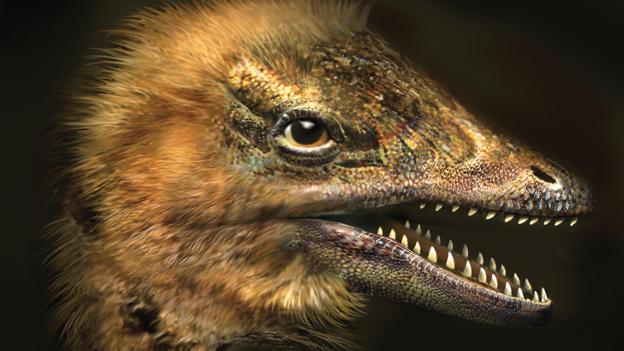
Further research has been done by geneticists at the University of Chile, focusing on the anatomy of the leg and foot, with promising results including a full-length fibula reaching the ankle.
The end goal is to create what Jack Horner refers to as the ‘chickenosaurus’, which he sees as a possibility, but realises there are huge hurdles to overcome. Evolutionary biology may in fact hold the key to the lock the fictional scientists in Jurassic Park were trying to open.
Rambunctious Reptiles or Feathered Fiends?
The traditional concept of a dinosaur was based in the reptilian realm; scales were the skin of choice. Despite a nod to the link to modern day birds, Jurassic Park retained the conventional lizard-like appearance of the dinosaurs.
The link to modern day birds extends to the possibility that dinosaurs may not have been as naked as tradition suggests. Fossilised bones show evidence not only for air sacks and hollows, but for the existence of feathers. Recent publications therefore suggest a radically different look to the ‘vicious-lizards’ than originally thought.
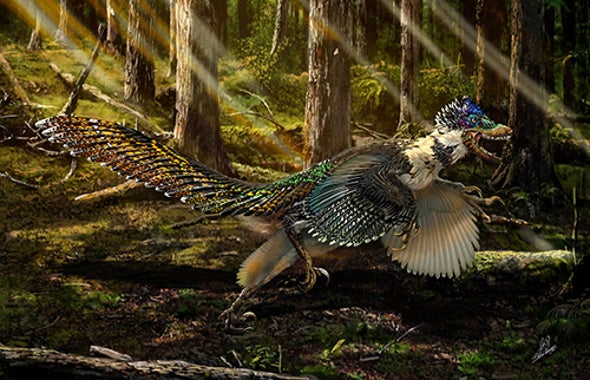
Using the Velociraptor for my feathered image was intentional, for it illustrates the other (fossilised) bone of contention. The appearance of the dinosaurs in the Jurassic Park series required a large amount of artistic license to be believable. The on-screen Velociraptors were actually modelled on Deinonychus, Utahraptor or Achillobator. Remains of real Velociraptors tell us they were in fact barely 2ft tall.
The Jurassic Park series does at least cleverly address the question of dinosaur realism:
What is left of them is fossilised in the rocks, and it is in the rock that real scientists make real discoveries! What John Hammond and InGen did at Jurassic Park is create genetically engineered theme park monsters! Nothing more and nothing less.
Dr Alan Grant. Jurassic Park III
Nothing in Jurassic World is natural! We have always filled gaps in the genome with the DNA of other animals. And if the genetic code was pure, many of them would look quite different. But you didn’t ask for reality, you asked for more teeth.
Dr Henry Wu. Jurassic World
Genetic engineering will never replace the realism of the dinosaurs. Perhaps the criticism was justified after all. The Jurassic Park scientists may have made dinosaurs, but given their process of biological engineering, can they be called dinosaurs at all?
Could Dinosaurs Survive Today?
Let’s pretend for just a minute we cracked the code of creation and dinosaurs were brought back to life. Yes, engineering these animals is one achievement, but that’s in no way the whole story. Our journey through life is not complete at creation. There is still the small matter of survival. Would a real life Jurassic Park be viable? Could these animals survive in today’s environment?
Straight off the bat, there is a slight issue surrounding nomenclature. If you look at the dinosaurs that made up the original park, it won’t take long to notice the majority came from the Cretaceous period. Thinking about it though, ‘Cretaceous Park’ doesn’t have the same ring to it. After all, we’ve already proven the dinosaurs weren’t accurate, so why should the name be, right?
Facetiousness aside for a minute, survival presents us with yet more problems, one of which is the climate. Throughout the Cretaceous period, global temperatures were around 4 degrees warmer than today, with four times the amount of carbon dioxide in the atmosphere. The dinosaurs lived in a constantly warming world with more consistent temperatures between the poles. The oceans too could reach temperatures up to 42 degrees, 14 degrees higher than even the warmest waters today.
Increased levels of carbon dioxide was not the only atmospheric difference. In school, we are taught there is around 21% oxygen in the air we breathe. If we reversed the clock 65 million years, that figure would have been much different. There are many that believe oxygen peaked at around 30% during the Cretaceous. It would explain how dinosaurs grew so much larger than even the mega-fauna of today. Recent studies with amber have however challenged this assertion, claiming the dinosaurs actually lived in a low-oxygen environment. If this is true, further studies would need to be undertaken into the colossal size of these animals.
One thing can be said for certain, the atmospheric composition was vastly different to today. Many of the dinosaurs would struggle to breathe properly. If the oxygen was as high as traditional studies suggest, existing today would be the same as us trying to do exercise on the top of Mount Everest, a little on the breathless side. Hardly ideal for survival if you ask me. Their biology evolved to survive in their climate, not a climate from the future.
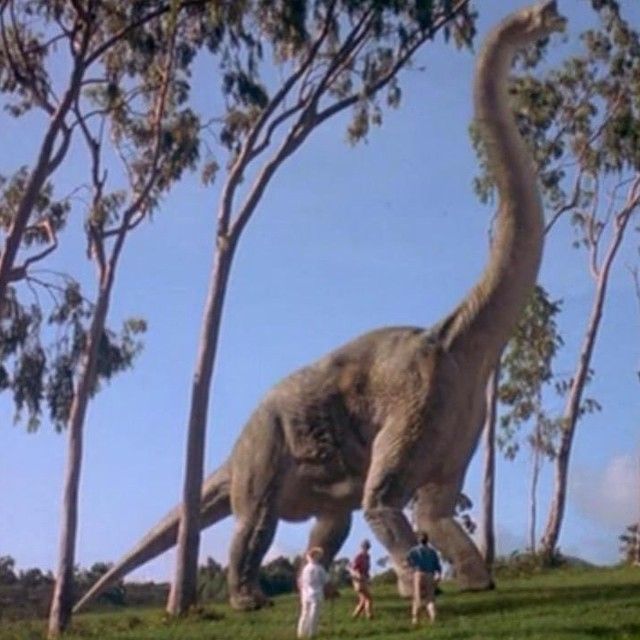
Finally, there is the question of habitats. There are pockets of land around the world which would be similar to that of the Cretaceous, such as humid wetlands or deserts. But the plains that saw the rise of animals like the Triceratops and Diplodocus do not have parallels; we have grass where they had ferns and primitive shrubbery. Imagine the sheer size of the land required to house (and feed) creatures like the gigantic sauropods. Don’t forget humanity’s love for expansion at any cost; when we can barely manage our own wildlife, should we really introduce dinosaurs into the mix?
The Important Question
I set out to find whether it would be possible to bring dinosaurs back to life. Despite my childlike hopes, however believable the science is, Jurassic Park is nothing more than a fantasy, masquerading itself in the real world. It did however serve as inspiration; perhaps there was another way, such as the idea of reverse engineering. There may be a few weird-looking chickens along the way, but we might just make some exciting leaps forward.
The question, however, is what would we create? We have no blueprint. We just have the world’s most difficult jigsaw with no guiding picture and an almost infinite number of pieces. The ‘reality’ of dinosaurs is an ever-changing picture; we have moved on from vicious lizards to creatures covered in feathers after all. Palaeontology exists to challenge the accepted view to further our knowledge, so the goalposts are forever on the move. Would we stay true to reality, even if we knew the reality? Could we resist abusing their existence in the pursuit of profit?
Genetic power is the most awesome force the planet’s ever seen, but you wield it like a kid that’s found his dad’s gun. You stood on the shoulders of geniuses to accomplish something as fast as you could, and before you even knew what you had, you patented it, and packaged it, and slapped it on a plastic lunchbox, and now you’re selling it. You want to sell it.
Ian Malcolm. Jurassic Park.
Even if we could bring dinosaurs back, what world would they be living in? What further changes would need to be made for them to survive in the 21st Century? What would become of the failed experiments? What life would they lead?
I started this by asking whether life could find a way. Perhaps I’ve been asking the wrong question. The question should never have been ‘how’. There are some things that are simply more important:
Your scientists were so preoccupied with whether or not they could that they didn’t stop to think if they should.
Ian Malcolm. Jurassic Park
 The Osiris Diaries