
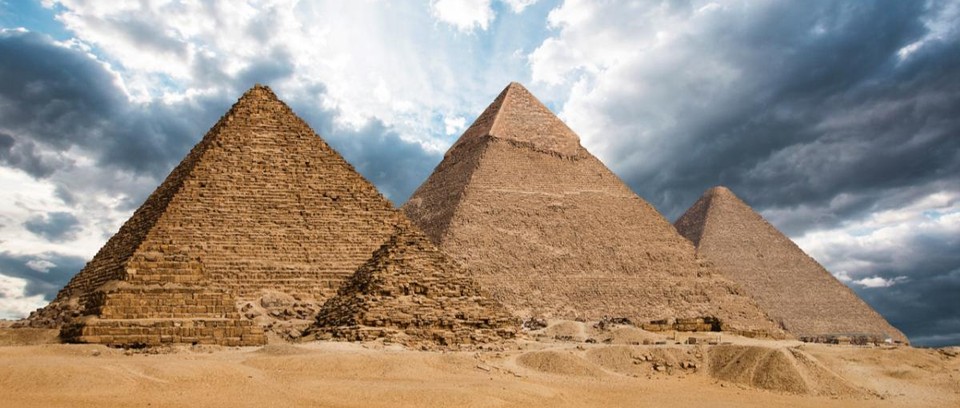
There are few monuments of the ancient world more recognisable than the pyramids of Giza. Rising above the desert, they have come to define 3,500 years of Egyptian history. Inevitably, ancient architectural accomplishments attract truly extraordinary explanations. The Egyptian pyramids are no exception. Were they built by aliens? Do they prove the existence of an ultra-advanced ‘lost’ civilisation? Or are they simply an evolutionary endpoint thousands of years in the making? The truth is out there.
An Alternative Archaeology?
The pyramids attract conspiracy theories like almost no other. Fans of Ancient Aliens will be more than familiar with the concept of extra-terrestrial visitors and their link to our ancient monuments. Traditional beliefs in ‘primitive’ societies have given many the impression our ancestors were a few blocks short of a pyramid; apparently humans need help from more intelligent beings to achieve any form of megalithic architectural expression.
This is expressed perfectly in the infamous publication Chariots of the Gods by Erich von Däniken, the book that kick started what has become known as alternative archaeology. The approach was simple: dismiss archaeology as the product of the biased elite, question everything and make generic statements with nothing but emotive language. This system lends itself perfectly to extra-terrestrials; if you dismiss literally everything else, then yes, aliens are the only answer.
Books like these, while being a beautifully entertaining afternoon read, do possess a power over the traditional academic arguments; they are impressively persuasive. They exist to appeal to the non-academic, while basing their arguments in emotion. But most importantly, aliens make for a much better Hollywood film than a debate over ceramic typologies or the use of ramps.
The Great Pyramid of Giza is the perfect icon for this alternative archaeology for one simple reason, the construction has never been fully explained by conventional research. The question of how the pyramids were built still dominates popular culture, focusing on the mystery and mysticism of the Egyptian past. However, through slotting the pyramids back into the historical narrative, I shall prove their construction as simply an evolutionary endpoint thousands of years in development.
I apologise in advance for ruining your fun.
The Evolution of the Pyramids
The site at Giza was developed during what has become known as ‘The Pyramid Age’ or the Old Kingdom (c. 2686-2100BC) by three Pharaohs: Khufu, Khafre and Menkaure. However, to understand the pyramids of Giza, first we must turn back the clocks and trace the development of Egyptian funerary architecture further into the past.
By the time the Great Pyramid was completed in around 2560BC, the Egyptian state had been in existence for nearly 600 years. However, what we have come to know as ‘Ancient Egypt’ began as far back as 6000BC. The Predynastic period set out the building blocks of the Egyptian kingdom, culminating in the unification of Upper and Lower Egypt in 3100BC. It is during this period of dynamic change our journey begins.
Predynastic Pit Burials (6000-3100BC)
Our story begins in much the same way as it did for the people of Egypt, with the landscape. The Nile brought life to the desert, cultivating the land and attracting both people and animals to exist together in this unique environment. For anyone that’s been to Egypt (especially during the summer months), what strikes you most is the heat. When studying archaeology, one of the first things you learn is extreme temperatures aid the preservation of organic materials. Organic materials include human remains.
Imagine yourself in Predynastic Egypt. Imagine you stumble over the body of a relative who had gone missing in the desert many years previously. One of the first things you see is their body hasn’t decomposed, with much of their hair and skin still very much visible. You decide to give them a proper burial, by digging a simple pit, laying the body inside and filling it with objects from their life. What you have here is the origin of one of the most famous Egyptian funerary practices, mummification. By drying and protecting the body, it preserves the human form. This concept of preservation would develop into a belief of remembering the dead, thus paving the way towards an afterlife.
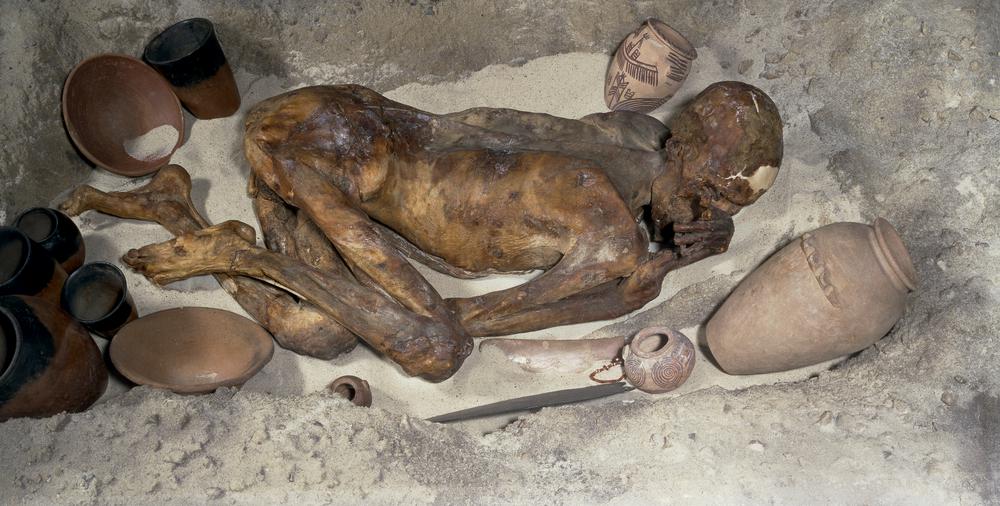
One of the most famous examples of a Predynastic burial exists within the British Museum. EA 32751 or The Gebelein Man (also given the nickname Ginger) dates to approximately 3400BC. Even after nearly 5,000 years, the natural mummification of the sand has preserved the corpse, including the hair. These burials formed the starting point for the Egyptian obsession with death. They kick started the monumental revolution in funerary architecture. In essence, these burials are the true origin of the Egyptian pyramid.
But what about after 3100BC? Once Egypt was unified, how do you bury a king?
Early Dynastic Mastaba Tombs (3100-2686BC)
The process of unifying a country under a single ruler naturally brings about changes to power structures. The Early Dynastic period saw power expressed through funerary architecture, further developing Egyptian thoughts on death and the afterlife. For the new elite, a simple pit burial just didn’t cut it anymore. They had to find a way of making their burial a little more, monumental.
Put simply, the mastaba tomb built (literally) on the established pit burials of the Predynastic. Early mastabas retained the shallow pit, but these were separated into rooms around a large mudbrick superstructure. The body, placed in a sarcophagus, lay in the centre with the surrounding rooms for grave goods. Over time, the burial chamber was placed further underground down an inclined shaft, often connected with stairs.
Saqqara Mastaba 3038 (c. 2800BC)
While many of the Early Dynastic kings and royal officials were buried at Abydos, one of the earliest funerary sites, some moved to the relatively newer site of Saqqara. It was chosen due to its’ proximity to the royal seat of power at Memphis.
During the original excavation of Saqqara, a mastaba from the reign of King Anedjib was discovered that displayed unique architectural features. Mastaba 3038 broke with traditional construction methods; its core was a stepped mudbrick mound on three sides during initial construction. However, when complete the stepped structure was partially hidden in favour of a palace facade and extended terrace.
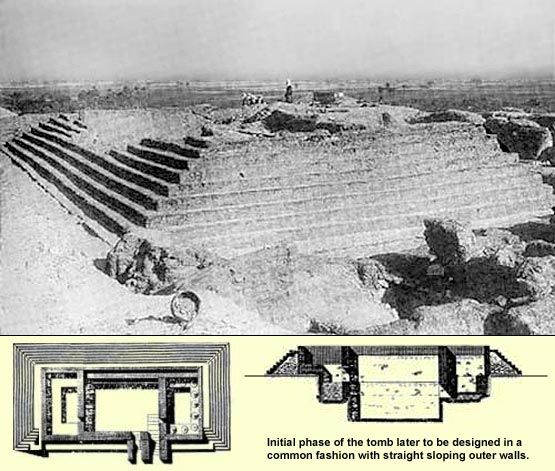
It’s no coincidence that barely 200 years later, an architect named Imhotep designed one of the most iconic funerary monuments in Egypt at the same site, inspired perhaps by mastaba 3038.
The Step Pyramid (c. 2670-2650BC)
The name Imhotep may sound familiar for those that have seen the brilliant, if slightly inaccurate, The Mummy and The Mummy Returns films. In actuality, Imhotep was not a high priest, but a gifted architect responsible for the earliest pyramid in Egypt. The Step Pyramid at Saqqara, just like the mastaba tombs of the Early Dynastic period, took the existing designs of funerary architecture one step further.
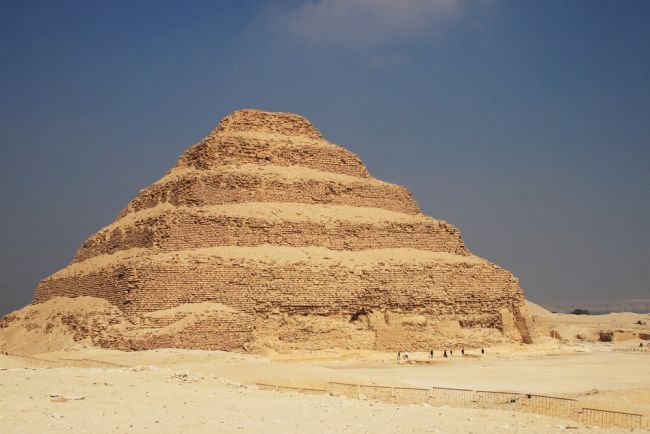
Constructed as the burial place for the 3rd Dynasty Pharaoh Djoser, the Step Pyramid was built with six steps, forming the centre piece to an impressive mortuary complex. The pyramid was constructed in six stages, beginning with what appeared to be a square shaped mastaba, before later being extended into a more rectangular shape. This would suggest this was an experimental design. This was also the first large scale masonry monument, with much of the rock argued to have come from the construction of the great trench which formed part of the complex.
The Old Kingdom is also known as the ‘The Pyramid Age’, for obvious reasons. It began with Djoser and the construction of the Step Pyramid, but tradition suggests the Egyptians weren’t finished just yet. They wanted to perfect their design.
Rise of the True Pyramid (c. 2613-2590BC)
Why the Pyramid?
The Old Kingdom is not just known for the pyramids, but for the rise of hieroglyphics. The Pyramid Texts are currently the oldest known body of Egyptian religious texts, first appearing at Saqqara towards the end of the Fifth Dynasty. They contain one of the earliest creation myths in history, the story of the primeval mound.
According to the myth, the world as we know it rose from the chaotic waters (personified as the goddess Nu). The first thing to appear from the waters was the primeval mound, represented as the benben. The original benben was said to be located at Heliopolis, representing where the first rays of sunlight hit the earth. This stone formed a pyramidal shape and replicas were used to top the pyramids of the Old Kingdom. This myth, like many of the religious beliefs of ancient Egypt, found its’ origins in the natural world.
Think about it like this, ancient Egypt existed because of the Nile. After the annual flood the water would recede, leaving behind the floodplains perfect for cultivation. The imagery of the primeval mound could very easily represent the moment new land appeared from the retreating water.
To put it another way, while at the beach, if you ask a child to make the biggest structure they can, chances are a mound will slowly appear before your eyes; largest at the bottom rising to a peak at the top. What would happen if you optimised that mound, emphasising the peak as a single point? You would be looking at a pyramid.
Put simply, the Egyptian pyramid represented the perfection of nature. It was the ultimate symbol of life, constructed as the ultimate embodiment of death.
Sneferu’s Three Pyramids
Sneferu was a pharaoh of the Fourth Dynasty. Given his building projects at the Dashur pyramid site, it’s a wonderful coincidence that his name translates to “he has perfected me”. If there was one who personified trial and error, it would be Sneferu and his lifelong obsession for pyramidal perfection.
The Meidum Pyramid: A Failed Experiment? (c. 2613BC)
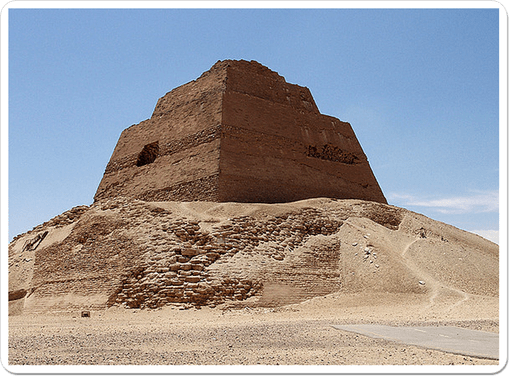
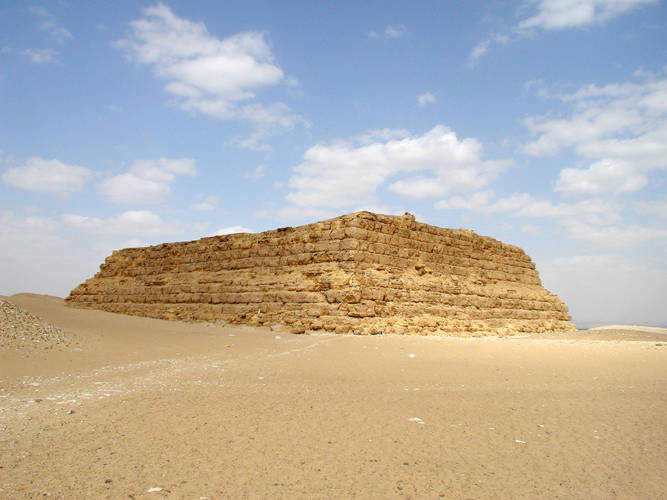
When Sneferu started his first building project, he set out with one clear goal in mind, to create the first true pyramid. His logic for achieving this was undeniable; the current step pyramid design could be improved by simply filling in the steps with limestone to create a smooth side. However, the steps themselves were not flat, thus creating instability when using it as a platform to create the smooth surface. Despite an uncertainty by archaeologists as to when, one thing is clear, the pyramid collapsed. The remains today show only part of the original stepped structure.
Sneferu would have to think again. It was time to take the next step.
The Bent Pyramid (c. 2600BC)

To create a true pyramid, the step pyramid design would have to be abandoned. Sneferu’s second building project at Dashur was the first attempt using this new construction method. The result is what has become known as the Bent Pyramid, for obvious reasons. Initially, the pyramid was planned with a 54 degree angle, but for reasons archaeologists cannot agree on, this was changed to 43 degrees near the top. If we assume the collapse of the Meidum pyramid had already taken place, the angle change may have been a safeguard. The engineers may have noticed similar instability, therefore deciding on a shallower angle to prevent collapse.
Sneferu was close now. Could he make it third time lucky?
The Red Pyramid (c. 2590BC)

Named for its’ reddish hue of the limestone blocks, the Red Pyramid represents a turning point in Egyptian funerary architecture. It is the first true pyramid of the Old Kingdom. The construction of the top of the Bent Pyramid showed the success of the 43 degree angle, so why not start with a 43 degree angle? The result is the third largest pyramid in Egypt.
Over a truly impressive period of only approximately 30 years, Sneferu finally achieved his true pyramid. But it would be his son who took the final step and achieved the ultimate dream; the perfect pyramid.
The Great Pyramid of Giza (c. 2560BC)
When Khufu took the Egyptian throne, the design of the true pyramid had been perfected by his father Sneferu, or so he thought. Khufu had other ideas. Gazing at the impressive Red Pyramid, something didn’t seem right. The pyramid looked a little, squat. The 43 degree angle was chosen after the compromised Bent Pyramid. 43 degrees worked, 43 degrees was safe. But to achieve greatness, you have to push the boundaries. When Khufu selected Giza as his new pyramid site, that is exactly what he did.
The Bent Pyramid became unstable at a 54 degree slope, but things had moved on since then. The question was, how far could you push the angle while retaining structural stability? The answer was 51.5 degrees.
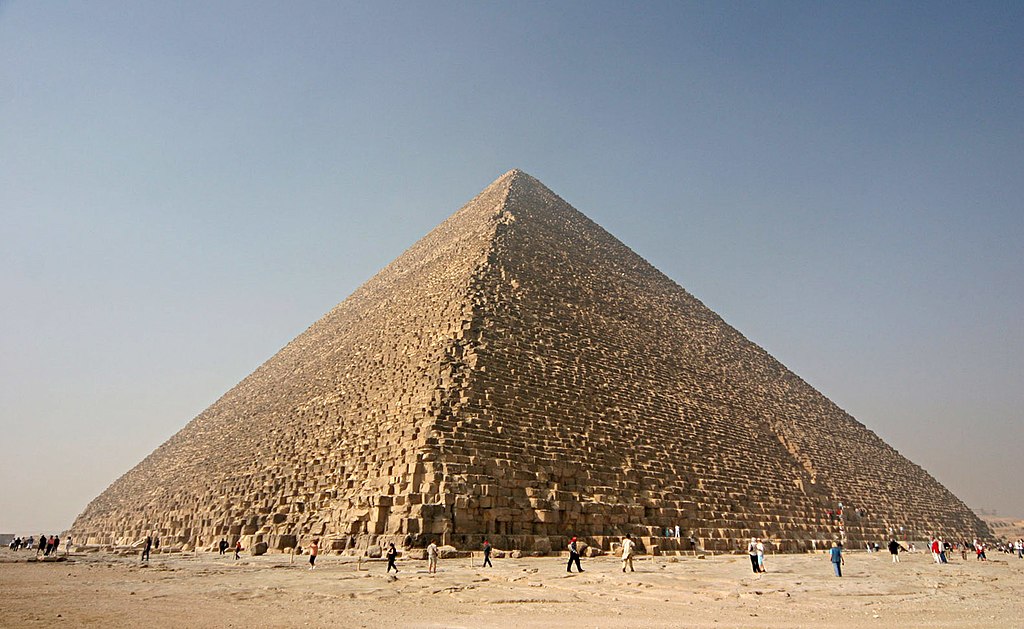
Towering above the desert at a height of 481ft (when originally completed), with a base of 756ft and a volume of 91,227,778 cubic feet, Khufu’s pyramid became the definition of monumental architecture. It’s been theorised the project took approximately 20 years to complete, using 2.3 million blocks of granite and limestone. When finished, the pyramid would have stood alone in the landscape, shining with its white limestone casing. It’s no wonder it became one of the Seven Wonders of the Ancient World. It took 3,800 years for the Great Pyramid to lose the title of tallest human-made structure in the world, losing to Lincoln Cathedral in 1311.
The other royal pyramids at Giza display three interesting features: they all follow the same design as Khufu, they are not as big and all sit in the shadow of their predecessor. If you follow the sight line from Menkaure’s pyramid through Khafre’s and Khufu’s, you will reach Heliopolis (the location of the original benben stone).
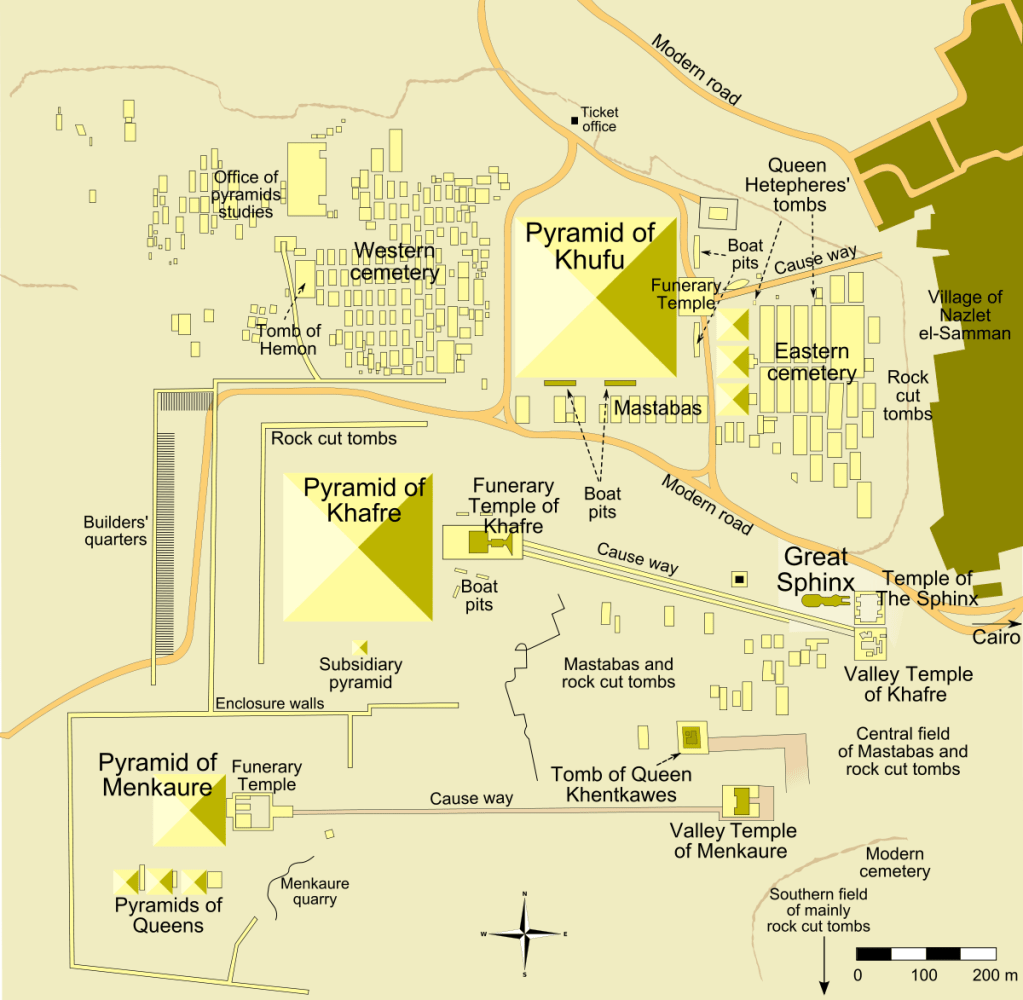
Understanding the complexities of the Great Pyramid would take a lifetime, including areas such as the use of contractor work forces, the workers’ town and of course the method of construction, but the end product proves one thing. To achieve such a building project would require immense economic power, further proof of the success of the Egyptian state of the Old Kingdom. The Giza pyramid complex personified the political, economic and religious power of the Egyptian kingdom.
The end of the Old Kingdom also marked the conclusion of grand pyramid projects; Egypt was thrown into turmoil following a famine and the breakdown of the political leadership.
A Celebration of Human Achievement
The popularity of alternative archaeology has given rise to a desire to discredit our past. Despite the achievements humanity makes every year, it seems somehow unfathomable to imagine such achievements were possible in the ancient past. The question is, why? The story of human society is a never ending narrative, one which needs a past. Without it, much of what we enjoy today wouldn’t exist. Perhaps it’s because we have struggled to recreate some ancient technology, but our brains convince us if we can’t do it, the people of the past definitely couldn’t. This, by the way, is ridiculous. I can’t do rocket science, but given the multitude of human objects in space, clearly others can.
The Great Pyramid of Giza is a celebration of human achievement. Taken in isolation, it would be hard to explain. But very little exists in isolation. Starting with the Predynastic pit burials, to the mastaba tombs of the Early Dynastic and the Step Pyramid of Djoser, these developments existed in parallel with the flourishing of the Egyptian state. Successive kings wanted to acknowledge the funerary architecture of their past, while also pushing the boundaries of what was possible, creating something new and expressing their power as ruler. The triad of pyramids by Sneferu is proof this didn’t always work.
By following these creations over the generations, the Great Pyramid is constructed in front of your eyes. At the height of the Old Kingdom, the Egyptian state had risen to become one of the most powerful in the world, characterised by a pyramid that stood above all else for 3,800 years. This was a symbol life, the embodiment of death and the perfection of the natural world existing in a single monument paying the ultimate tribute to all that had come before.
So no, it wasn’t aliens. But the real story is much more fascinating, with many questions still to be answered. The Giza pyramids represent a cultural and architectural evolutionary end-point thousands of years in the making. They were the dramatic final act in one of the greatest stories ever told.
 The Osiris Diaries