

History is the study of the past, covering the full spectrum of the human experience leading up to this very moment as you read these words. The discipline prides itself on piecing together the puzzle of our existence, asking the big questions along the way. But what if I told you that history suffers an extraordinary identity crisis? In our quest to study the past, are we simply decoding the complexities of the present? They say history is written by the winners, but that’s merely the beginning. This is history’s great hypocrisy.
Across this wreckage of rambunctious rambling laid forth before you, much of the information will not contain knowledge you do not already possess. After all, the teaching of history is ingrained into the foundations of our education system. From a young age, armed only with the tools of reconstruction, we are thrust into the mesmerising worlds of time gone by. As the years of guided research progress ever forward, our talents for analysis are refined, culminating in a potent skillset to question the very fabric of the established historical narrative. And yet, as we liberate ourselves from the restrictions of education, the complexities of critical thought that once dominated our approach to the past become twisted in the dense jungle of the everyday world. We are threatened by the seduction of the superficial, rejecting the research in favour of simple statements of fact. To understand the power of the past, first we must ask a seemingly simple question: what is history? Or, more importantly, whose history?
What History? Whose History? Why History?
Despite a widely held assumption of history as objective fact, our basic understanding of the past comes from nothing more than story telling. Would you describe the telling of stories as an objective, factual narrative? Or would you instead refer to it as subjective, existing as a both an expression of the event but also that of the person who witnessed it. Could you ever honestly say you’ve never subtly embellished your narrative to better suit your argument? That’s what I thought.
The intriguing transformation from subjective story to historical fact requires just one additional factor – the introduction of authority. Of the multitude of manifestations this authority can take, the commonality lies in their power of influence. The authority values, verifies and validates these stories, thus qualifying these stories as worthy of promotion into ‘history’. In an ideal world, this hypothetical authority would provide detached, objective and critical analysis to these stories, before proclaiming the ‘official’ version of events. Alas, such a place does not, nor will it ever exist. The declaration of history intertwines the stories of the past with the context of the contemporary. To control the historical narrative is to wield the power to influence those under your authority.
The only real truth is the full picture of the past will never be uncovered. Evidence we gather gives us nothing more than a brief glimpse into history, and to argue anything else would, simply, be wrong. Once again, this calls into question the very definition of history itself. Conflicting identities see history as an academic discipline, the events upon which the discipline is based and the cherrypicked version used as political manipulation. It may be biblically overused, yet ‘history is written by the victors’ is so scintillatingly simple and beautifully brilliant in its accuracy.
The classification of state history is determined by contemporary context; governments choose the national story to best suit their ideology. Even families choose a history for their audience, whether this be as a lesson for the children or the oneupmanship of the social gathering. In essence, our utilisation of history boils down to the basic manipulation of data in the construction of an argument. With all these factors at play, it’s vital to be critical when presented with a version of the past. If we trust authorities with delivering historical ‘fact’, we are missing the very spirit of historical study, while setting a menacing precedent; to accept without question is to raise beyond criticism into the potentially dangerous ‘sacred’ realm.
If a person or an institution are held sacred by too many people, then they are by definition beyond criticism. And when a person or an institution becomes beyond criticism, it seems they slip inevitably towards corruption
Tim Minchin
The Rightful King?

It was Phil Collins who once so eloquently told us we always need to hear both sides of the story. History should never be a single sided statement; history deserves critical conversation. To simply accept the story from those who shout the loudest is to ignore the very essence of the historical narrative. Nothing is as cut-and-dried as right or wrong, good or bad, fact or fiction. It’s all a question of perspective.
Imagine, if you will, two people looking at a complex object. Now, if you asked those people to describe what they saw, would they say the same thing? What if they were viewing the same object from different sides of a room? As they describe what they see, a divergence appears in both the construction of the object as well as the immediate environment in which it exists. Put simply, our understanding of the world is determined by our own unique perspective. Thus, our perception of the past is defined by our own personal circumstances. If we want to understand events the past, first we must acknowledge the existence of multiple frames of reference, apparent in both the context of their time as well as our own.
Let’s take the Norman Conquest of England in 1066. William the Conqueror’s decision to invade was focused around his belief that he was the rightful heir to the English throne. When King Edward the Confessor died however, it was Harold Godwinson that became England’s leader. Some sources argue that Edward promised the throne to William, sending Harold to Normandy to confirm this. Others stated Edward had never offered the throne to William, given his decision to track down the last of his bloodline in the Hungarian born Edgar, son of Edward the Exile. But it was Harold Godwinson that was named successor, with a selection of sources claiming Edward declared this on his deathbed.
The written sources of the time come from both England and Normandy, both positing, as you can imagine, astonishingly contrasting accounts of these events. When assessing the Norman Conquest, it’s impossible to ignore possibly the most famous artefact of the time, the Bayeux Tapestry. The tapestry illustrates the events of the Norman Conquest story – but what story? Who commissioned it? Who made it? Are there hidden messages that lie beneath the surface? Most importantly, whose story are we seeing? Historians have discussed, debated, and disagreed over these questions, both refusing to yield.
When reading popular books on history, there is a subconscious assumption by the reader of objective knowledge within the content. In actuality, it’s impossible to present history without the integration of author’s opinion. This inevitable bias appears in the impressive range of publications concerning the Norman Conquest. Case studies surrounding the now legendary leaders inexorably deliver these figures in a biased spotlight; both Harold Godwinson and William the Conqueror were inspirational figures in their own right and are fully deserving of the credit they receive. But one’s credit can often become the other’s criticism. Even those whose research is devoted to revealing the entire story of the Conquest have taken sides. It takes just a single word to reveal great favouritism; by asserting for example that Harold “stole” the English crown suggests a pro-William view. While of course there is no harm in sharing your interpretation, it’s vital you don’t present this as indisputable fact. Words possess great power, and to abuse this power can lead to dangerous consequences. Never before has this been more apparent than in our contemporary political climate.
Fact or Fake News?
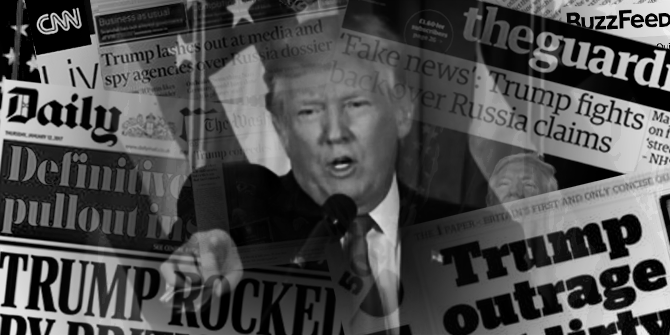
The manipulation and abuse of data is so ubiquitous within the political realm it has become normalised, expected, and most worryingly, accepted. Whether an event, research or survey data, politicians seek to sculpt conclusions that best fit their ideological standpoint. They deliver these arguments to the nation, their followers accepting this opinion as undeniable fact. Another danger comes in the use of political authority to present unsubstantiated claims as objective knowledge. In the political universe, power and influence often trumps the validity of fact. Speaking of which, the story of Donald Trump provides the perfect case study to understand the poisonous potency of presenting the past in a position of power.
Politics often forms the backbone of our past; decisions made by those in the highest echelons of power will one day trickle their way down to the history books. Their actions define our future, while heavily influenced by the past. Over the last four years, for good or bad, it’s been difficult to ignore the staggeringly memorable presidency of Donald Trump. Many books will undoubtedly be written on US politics under the Trump administrations, thus entering the 45th President into our collective historical narrative. But what narrative? When it comes to Donald Trump, it’s impossible to separate his time in the Oval Office from another term – fake news.
Trump’s narrative has both ridiculed the importance of historical accuracy, while simultaneously fitting the role of the stereotypical politician. The strength of support, combined with the power of his position, convinced Trump’s followers that he was the only one to speak the truth. While it’s nothing new for media companies to spin news stories to fit their own ideology, the President managed to attack the mainstream media for publishing false stories, while simultaneously spreading his own brand of misguided ‘truth’. The President was officially impeached, yet his followers still believe the terms of this impeachment to be unjust. The strength of the Republican Party in the Senate made sure Trump was acquitted of all charges brought against him, thus using the political system to alter the narrative.
Despite many claims proven incorrect from numerous sources, the raw power wielded by the President rendered this practically a moot point. And of course, the US is not alone in its manipulation of the past, the story remains the same in the UK. The Conservative government spin their failures as victories, shifting the blame to the Labour opposition, while Labour find ‘proof’ to criticise every action taken by the Conservatives. In a battle over who has the largest, let’s call it, ‘majority’, the employment of critical thought is insignificant compared to the power of shouting louder, longer and more convincingly than everyone else. We teach our children the importance of listening, politeness and justified arguments, while our leaders squabble like toddlers fighting over a toy. It really is brutally ironic, isn’t it?
Presenting the Past in the Present
It’s only by gazing into the mirror of your own time can you begin to grasp the bafflingly beautiful complexity of the human experience. If our own lives are anything to go by, understanding the past is much more than a few brief awkward lines. Imagine someone trying to objectively explain the Trump administration 250 years in the future; chances are the subsequent account will be shrouded in a subconscious biased brevity. The author will have taken their view on Donald Trump and woven this into the foundations of their argument.
In our eternal quest to understand the past, we must undertake an intricate decoding exercise. Any presentation of the past has been subjected to multiple layers of bias by those deciding to record it. Firstly, you take into account the personal beliefs of the author. Secondly, the society the author lives in at the time of writing – it’s natural to project the views of your time onto the past. Our contemporary experience cannot be directly compared to that of the past; put simply we live in very different worlds. And finally, the primary sources we now rely on have their own subjective agendas. So, between the bewildering barrage of stories from US politics and the argument over the rightful king of England in 1066, it’s fair to say the study of history is anything but simple.
History is storytelling. Storytelling is a subjective narrative. Subjective narrative forms objective fact. Objective fact rises beyond criticism, thus becoming ‘history’. From the family unit, through the local community, charging passed national politics all the way up to international organisations, this dangerous process has become entrenched on all levels of society. The mind boggling nexus of narratives at play can only really lead to one conclusive question – can we really accept anything as objective fact?
Archaeology is the search for fact, not truth. If it’s truth you’re looking for, Dr Tyree’s philosophy class is right down the hall
Henry Jones Jr (Indiana Jones and the Last Crusade)
So what I’m saying, if I’m saying anything at all, is this – don’t be afraid to question the narrative. Those invaluable skills of critique, analysis and investigation gifted unto us during our formative years can help us navigate the minefield of subjectivity, manipulation and abuse in search of fact. To simply accept the words of others is in the name of history is humanity’s great hypocrisy.
The human journey is constructed not just on a foundation of storytelling but an eternal quest for discovery. To therefore reject stories on the basis of their bias would be to reject the very basis of human culture, but then what is more human than to interrogate the establishment in search of something more? By questioning their own world, our ancestors forged a path towards our future. Our approach to history should be no different. By learning the lessons of our own time, we can begin to unravel the mystery of history. History is the past, its study is the present, and its consequence is the future.
History is humanity.
 The Osiris Diaries