
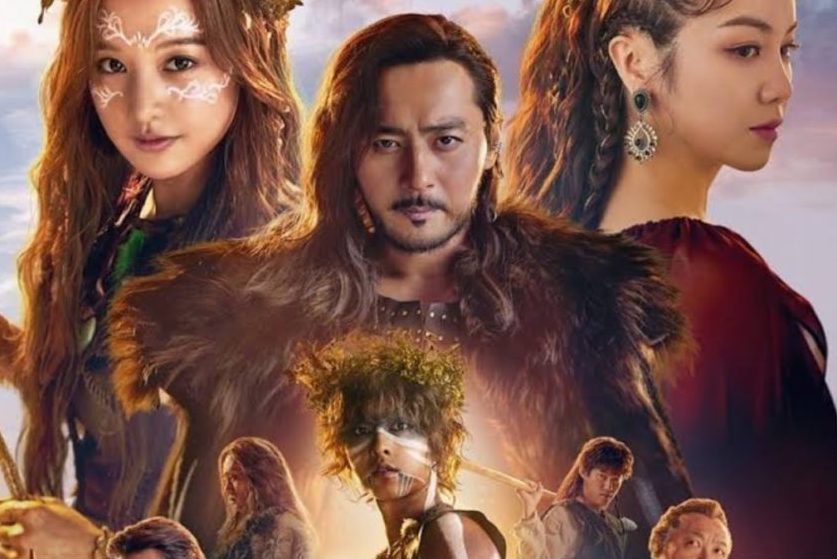
While life during a global pandemic has been challenging, it has presented certain opportunities, including the most precious commodity of all – time. I took the decision to expand my visual entertainment horizons, leaving the comfort of the English speaking territory far behind and venturing into something new. Having enjoyed some spectacular Korean films, I noticed one repeated recommendation, so I gave it a go. In my mind, and after only a single season, ‘Arthdal Chronicles’ has fast become one of the ultimate historical fantasy epics ever produced.
Watching Arthdal Chronicles is no simple undertaking. As a pure time commitment, the season is comprised of 18 episodes, each of around 80 minutes. To put that in perspective, the longest season of Game of Thrones was 567 minutes. Arthdal Chronicles comes in at an earth shattering 1440 minutes (approximately), a staggering 2.5 times longer than Game of Thrones. But Arthdal Chronicles is more than just a time commitment, it’s something that will challenge you on every level, from politics, religion and even our understanding of humanity itself.
Set in the fantasy land of Arth, at its heart the show deals with the relationship between humanity and the Neanthals. Considered less advanced but highly adapted to the natural world, the Neanthals are feared, leading to a brutal genocide which obliterates their population. There are, of course, obvious comparisons to be made between the story of Arth and the story of the Neanderthals. The story of Arthdal Chronicles sees an ever expanding human society, the Arthdal Union, fighting for survival and dominion over the land of Arth.
We are also introduced to the Igutu, a name given to those who are born of human and Neanthal parents. Much like the blue-blooded Neanthals, the Igutus are hunted by the people of Arthdal, identified by their distinctive purple blood. Across the season, the power politics of Arthdal takes centre stage, including the religious, technological and military tensions bubbling beneath the surface. While based in fantasy, similarities can be drawn between Arthdal Chronicles and the founding of the first Korean kingdom of Gojoseon during the Bronze Age by legendary leader Dangun.

One of the standout elements that makes Arthdal Chronicles such a success is the scintillating performance of the cast. You are thrust into the land of Arth, emotionally connected with these characters with such intensity it almost takes you by surprise. Of course none of this would be possible without the outstanding production of the series – the seamless transition between spoken dialogue and inner monologue creates new dimensions to these characters, inviting a personal relatability and understanding often unseen in other series.
Song Joong-ki portrays one of the central characters, Eun-seom. Eun-seom is an Igutu who escapes death as a child, eventually raised by the people of the Wahan tribe. Across the 18 episodes, you watch a charming childlike innocence disappear as the hard realities of his situation force Eun-seom down a difficult path; there is a genuine realism to his astonishment, confusion and horror when the world he knew is ripped away. Song Joong-ki delivers an adventure not confined to the physical; its his emotional journey that transforms this fantasy series into something human, something real. But Song Joong-ki doesn’t stop there, he also plays Saya, another major character in the show.
Saya is the mysterious son of Ta-gon, leading a sheltered life dominated by reading. As a complete contradiction to the selfless kindness of Eun-seom, Saya is shrouded in a cold selfishness; his academic, almost emotionless approach to society removes the humanity from his character. Despite their differences however, Saya too discovers the real world for the first time like Eun-seom, proving the importance of personal perspective in understanding the world.
Another standout performance is the character Ta-gon, played by Jang Dong-gun, the people’s champion and son of the Union Leader. Through Dong-gun’s utterly sensational performance, Ta-gon is presented as god-like, oozing leadership, strength and personal ambition. Some of the best actors don’t need to vocalise to communicate, and this is exactly what makes Ta-gon so powerful; a single glance pierces into deep into your soul, a simple hand movement commands respect, and a stance so strong it strikes fear into all that look upon him.

What makes a series successful? On the surface, the ideal fantasy recipe includes action, suspense, escapism, emotion and inspirational realisations. But these shows also require more – they require a certain complexity. While our society is far removed from theirs, the best series expose the shocking similarities to our reality, forcing us to consider ourselves on a deeper level. This is the crowning glory of Arthdal Chronicles.
Arthdal Chronicles considers the concept of people and their role within the intricacies of state formation. It provides cultural distinctions between the organisation of a clan or tribe when compared to the intense mechanics and infrastructure of a political union and the eventual transformation into a single nation or kingdom. The fragile interplay between politics, religion and technological advance defines the difficulties of stability; the inherent authority and power wielded by religious leaders can be used to manipulate and dismantle political control. The Arthdal Union is powerful in its unity, while simultaneously pitting individuals against each other in their eternal quest for influence, authority and profit. It could indeed be argued that the inherent energy and tension of instability benefits the success and lasting stability of the union – it’s all about balance.
When introduced to the Wahan tribe, we see people living a life without luxury, power and prejudice. They are people that live with the land, but do not own the land. Similarities can be drawn to elements of socialism and the equality of power. However, once removed from their home and forced to live in Arthdal, they are slowly seduced by the attraction of capitalism. Some become twisted by their lust for power, while others use it to break the system from within. It goes to show the true corruptive and destructive nature of power; we risk losing our defining values in our demand for more profit, power, and control.
By addressing issues of oppression and status, Arthdal Chronicles brings into question our own morality and the often brutal effect of perspective. For the people of Arthdal, genocide and the taking of slaves is necessary for their continued expansion, success and survival. The bi-products of such decisions spawn the essence of racism, intolerance and prejudice. Horrifying comparisons can be made here to the events surrounding the Holocaust and the continuing antisemitism today.
Similarly, Arthdal Chronicles cleverly warns against the dangers of absolutes; to say things are either good or bad, right or wrong, black or white is to ignore the multiplicity of the human experience. The show boasts a fluid approach to morality, with different characters straddling the traditional boundaries of ‘hero’ and ‘villain’ as the plot develops. Simple definitions of good and bad depend heavily on our own point of view within our own time. The fluidity of our morality as a product of an ever-changing narrative is the foundation of our humanity.

What more is there to say about Arthdal Chronicles? The series contains performances that transcend the realms of traditional television, supported by utterly beautiful cinematography. At a time when we need it most, Arthdal Chronicles represents the ultimate escape.
While many would find it easy to compare the show to Game of Thrones (in fact I did), they exist in two separate spaces linked only by their genre. Despite the focus on the mystic and the magic, there’s a sense of believable realism you simply don’t get in Westeros. There’s an argument to be made for Arthdal Chronicles attempting to bridge that unholy gap between religion and science through placing the spiritual narrative within the context of the real world. The diverse stories, overarching narrative, difficult questions of self-reflection and emotional rollercoaster ride have come together to produce one of the great historical fantasies. And the best part? The story is only just getting started.
Arthdal Chronicles has been renewed for a second season, but production has been indefinitely postponed due to the COVID-19 pandemic. However long it may take, I can promise you the second season will be well worth the wait.
 The Osiris Diaries
I cannot agree more with you, Arthdal Chronicles is an amazingly powerful show; the intense, layered thoughts that reside within us all is not only brought into the foreground but is also awarded/ destroyed/ played with.
Kudos to the entire team!
Also, enjoyed reading your superb post.
Thanks!
p.s – only recently I wrote a post on this show, you can read it here – https://www.chimingstories.in/2021/02/arthdal-chronicles-unfolding-of-the-epic-saga.html
LikeLiked by 2 people
I’ve just been giving your post a read, incredible analysis on each character and the success of the show itself!
LikeLiked by 1 person