
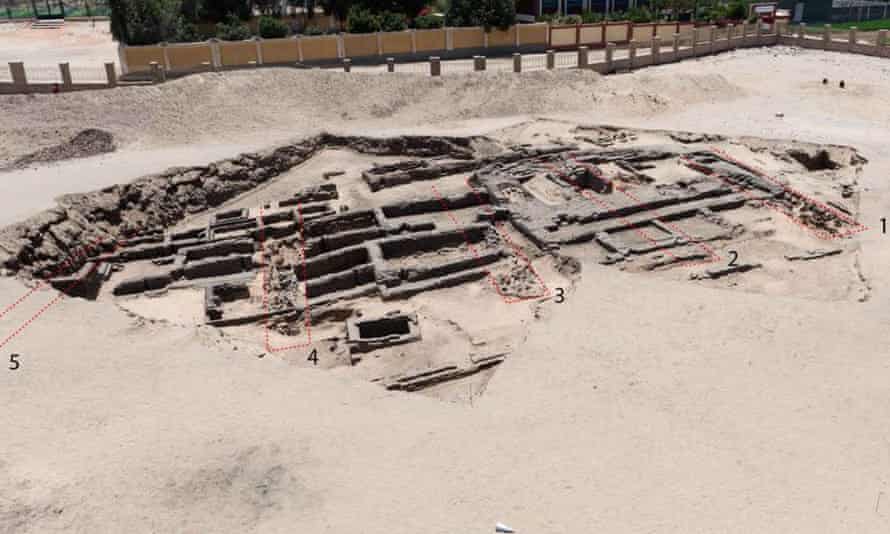
Beer is a global product, ranking as the third most popular drink behind water and tea. In 2018, the industry was worth nearly $700 billion, expected to rise to over $950 billion by 2025. Not only is beer the most widely consumed alcoholic drink in the world, but it is undoubtedly one of the oldest, with the Ancient Egyptians widely credited as the first to perfect the fine art of production. And recently, archaeologists working at the sacred site of Abydos have discovered what could just be the world’s oldest large-scale brewery, dating back around 5,000 years.
Since the early 20th century, archaeologists had evidence to suggest a link between beer production and Egyptian funerary practices, leading to the tantalising idea of the existence of a large-scale brewery at Abydos. Alas, they were never able to pinpoint its location, until now. As announced by Mostafa Waziri of the Supreme Council of Antiquities, a team of American and Egyptian archaeologists have unearthed a huge factory, comprised of 8 large units. Each of these units measures around 20 metres (65ft) long and 2.5 metres (8ft) wide. Contained within are 40 pottery basins in two rows – these vessels would heat the combination of grains and water to produce the all important beer, specifically a staggering 5,000 gallons (22,400 litres) at a time.
This new discovery has been attributed to the the Early Dynastic Period (c. 3150 – 2613 BCE) and the reign of King Narmer, the Pharaoh credited with unification of Upper and Lower Egypt. Many Egyptologists now ascribe the true identity of the mythical Menes, celebrated as a legendary figure who unified Egypt, as King Narmer. It’s from this period we have one of the most important artefacts of Egyptian history, the Narmer Palette. Archaeologically, this single object represents the birth of the Egyptian kingdom.

Throughout the predynastic era, Abydos emerged as one of three centres of power, alongside Naqada and Hierakonpolis. Abydos overcame its rivals and would hold dominion in Upper Egypt, with the necropolis at Umm el-Qa’ab becoming the royal burial ground of the early Egyptian state, including Narmer, his Protodynastic predecessor Ka, and his successor Aha. Abydos grew into one the most sacred sites of Egypt and the cult centre of the god Osiris. The tomb of the early dynastic ruler Djer was later revered as the tomb of Osiris himself.
It was during the Early Dynastic era when rulers consolidated power and laid the foundations for what would become the glory of Old Kingdom Egypt. Part of this infrastructure of course included the centralisation of religion and the establishment of cities for the dead. But in addition, the early Pharaohs needed an effective economy based on supply, production, and trade. In essence, Egypt ruled through economic and religious power. And this is where the beer comes in.

According to Egyptian mythology, beer was one the many gifts given to humanity by the gods. Interestingly enough it’s Osiris who is said to have not only given the gift of agriculture, but instructed them in the brewing of beer. While beer had previously been made in Mesopotamia, the Egyptians receive credit for the ‘first beer’ due to its similarity to our modern day drink. The brewing of beer was originally undertaken by women as a domestic exercise; it was only when presided over by men when production became state controlled. Unlike the beer of today, it was drunk mainly as a rich source of nutrients rather than an intoxicant.
Early Egyptian beer would taste more like a fruit drink than the beer we are accustomed to. Both hops and carbonation were unknown entities; beer was made by mixing water with bread and placing this into heated jars to ferment. The dark red appearance and slight fruity flavour came from the addition of dates and honey to the mixture. As the Egyptian kingdom developed so did the ingredients, recipe, and brewing process. But it’s fair to say the story of beer is fundamentally linked to the story of Egypt itself.
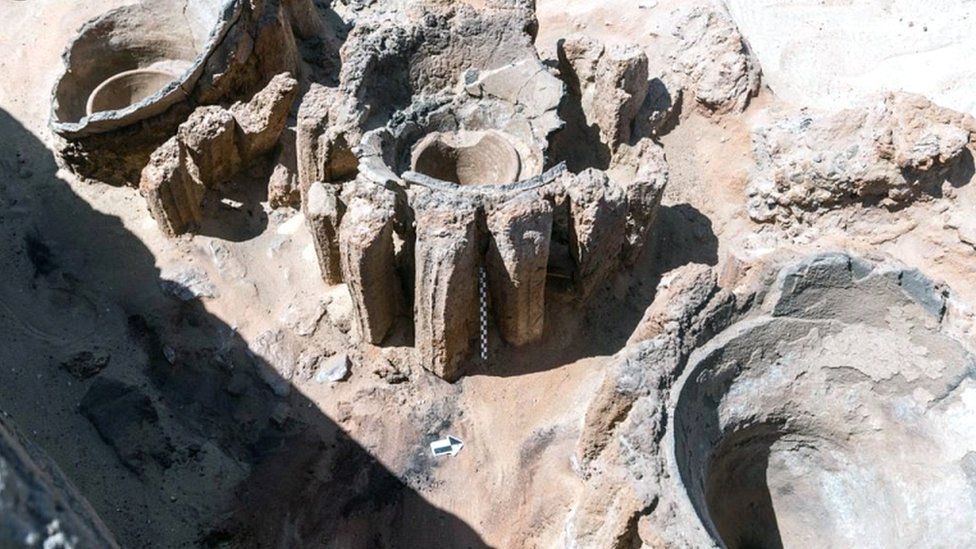
To unearth a brewery of this size at Abydos, dating to the early days of a united Egypt reveals the astonishing complexity of state formation. Thus, what once were domestic activities had to be enlarged to near-industrial levels to fulfil the demanding requirements (economic, logistical, and spiritual) of the new state administration. The first pharaohs needed to centralise the crucial networks of production, distribution, and trade, while establishing the intricate framework of urban and funerary spaces. This infrastructure created the political, ideological and religious image that defined their new culture.
Beer crossed the boundaries of the living and the dead; a vital commodity for both the growing population of Egypt and the gods they worshipped. In many ways this is more than just a brewery, this is the beginnings of one of the greatest societies of them all – this brewery is the foundation upon which ‘Ancient Egypt’ was born.
The real intoxication of the site comes not from the beer that once was produced there, but the lure of archaeology itself. This brewery stakes its claim as the oldest in the world, but in truth such a statement is almost an insurmountable impossibility. Discovering the past is a dynamic journey of forever fluctuating parameters. Instead, therefore, of claiming this to be the oldest large scale brewery in the world, it would be more accurate to say this could be the oldest brewery that we know of. Reconstructing the past can never be an exact science, and working to unravel this mystery is the unfathomable joy of archaeology.
 The Osiris Diaries