Aliens Built the Pyramids

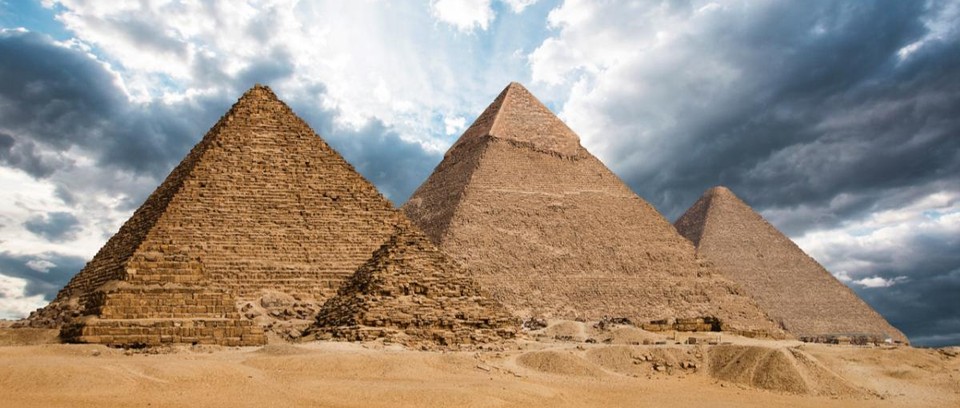
There are few monuments of the ancient world more recognisable than the pyramids of Giza. Rising above the desert, they have come to define 3,500 years of Egyptian history. Inevitably, ancient architectural accomplishments attract truly extraordinary explanations. The Egyptian pyramids are no exception. Were they built by aliens? Do they prove the existence of an ultra-advanced ‘lost’ civilisation? Or are they simply an evolutionary endpoint thousands of years in the making? The truth is out there.

An Alternative Archaeology?

The pyramids attract conspiracy theories like almost no other. Fans of Ancient Aliens will be more than familiar with the concept of extra-terrestrial visitors and their link to our ancient monuments. Traditional beliefs in ‘primitive’ societies have given many the impression our ancestors were a few blocks short of a pyramid; apparently humans need help from more intelligent beings to achieve any form of megalithic architectural expression.

This is expressed perfectly in the infamous publication Chariots of the Gods by Erich von Däniken, the book that kick started what has become known as alternative archaeology. The approach was simple: dismiss archaeology as the product of the biased elite, question everything and make generic statements with nothing but emotive language. This system lends itself perfectly to extra-terrestrials; if you dismiss literally everything else, then yes, aliens are the only answer.

Books like these, while being a beautifully entertaining afternoon read, do possess a power over the traditional academic arguments; they are impressively persuasive. They exist to appeal to the non-academic, while basing their arguments in emotion. But most importantly, aliens make for a much better Hollywood film than a debate over ceramic typologies or the use of ramps.

The Great Pyramid of Giza is the perfect icon for this alternative archaeology for one simple reason, the construction has never been fully explained by conventional research. The question of how the pyramids were built still dominates popular culture, focusing on the mystery and mysticism of the Egyptian past. However, through slotting the pyramids back into the historical narrative, I shall prove their construction as simply an evolutionary endpoint thousands of years in development.

I apologise in advance for ruining your fun.

The Evolution of the Pyramids

The site at Giza was developed during what has become known as ‘The Pyramid Age’ or the Old Kingdom (c. 2686-2100BC) by three Pharaohs: Khufu, Khafre and Menkaure. However, to understand the pyramids of Giza, first we must turn back the clocks and trace the development of Egyptian funerary architecture further into the past.

By the time the Great Pyramid was completed in around 2560BC, the Egyptian state had been in existence for nearly 600 years. However, what we have come to know as ‘Ancient Egypt’ began as far back as 6000BC. The Predynastic period set out the building blocks of the Egyptian kingdom, culminating in the unification of Upper and Lower Egypt in 3100BC. It is during this period of dynamic change our journey begins.

Predynastic Pit Burials (6000-3100BC)

Our story begins in much the same way as it did for the people of Egypt, with the landscape. The Nile brought life to the desert, cultivating the land and attracting both people and animals to exist together in this unique environment. For anyone that’s been to Egypt (especially during the summer months), what strikes you most is the heat. When studying archaeology, one of the first things you learn is extreme temperatures aid the preservation of organic materials. Organic materials include human remains.

Imagine yourself in Predynastic Egypt. Imagine you stumble over the body of a relative who had gone missing in the desert many years previously. One of the first things you see is their body hasn’t decomposed, with much of their hair and skin still very much visible. You decide to give them a proper burial, by digging a simple pit, laying the body inside and filling it with objects from their life. What you have here is the origin of one of the most famous Egyptian funerary practices, mummification. By drying and protecting the body, it preserves the human form. This concept of preservation would develop into a belief of remembering the dead, thus paving the way towards an afterlife.
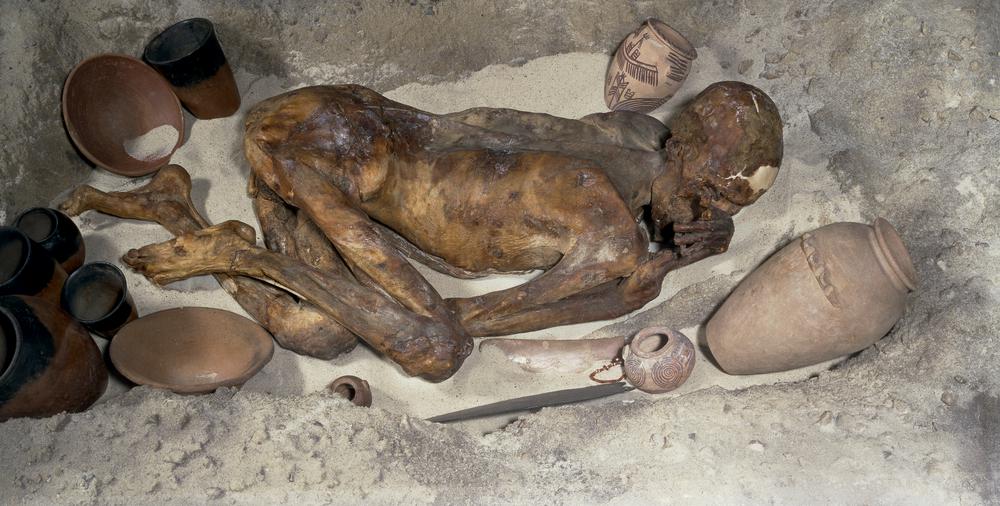
The true origin of the pyramids in Egypt. Image Credit: The British Museum

One of the most famous examples of a Predynastic burial exists within the British Museum. EA 32751 or The Gebelein Man (also given the nickname Ginger) dates to approximately 3400BC. Even after nearly 5,000 years, the natural mummification of the sand has preserved the corpse, including the hair. These burials formed the starting point for the Egyptian obsession with death. They kick started the monumental revolution in funerary architecture. In essence, these burials are the true origin of the Egyptian pyramid.

But what about after 3100BC? Once Egypt was unified, how do you bury a king?

Early Dynastic Mastaba Tombs (3100-2686BC)

The process of unifying a country under a single ruler naturally brings about changes to power structures. The Early Dynastic period saw power expressed through funerary architecture, further developing Egyptian thoughts on death and the afterlife. For the new elite, a simple pit burial just didn’t cut it anymore. They had to find a way of making their burial a little more, monumental.

Put simply, the mastaba tomb built (literally) on the established pit burials of the Predynastic. Early mastabas retained the shallow pit, but these were separated into rooms around a large mudbrick superstructure. The body, placed in a sarcophagus, lay in the centre with the surrounding rooms for grave goods. Over time, the burial chamber was placed further underground down an inclined shaft, often connected with stairs.
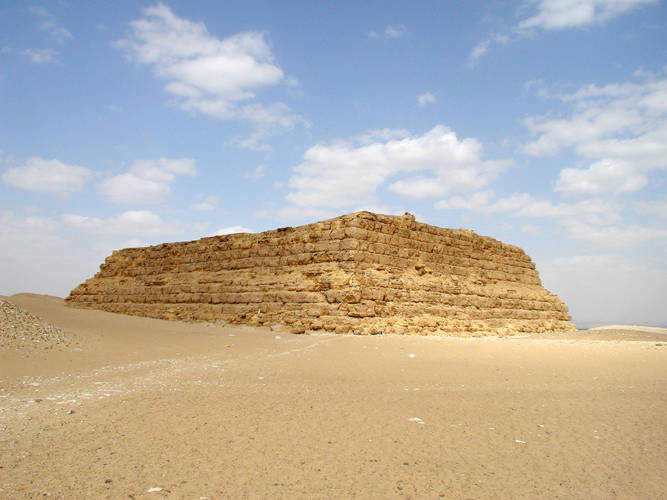
The Egyptian mastaba tomb looks suspiciously like an unfinished pyramid. Image courtesy of Egypt Archive.

Saqqara Mastaba 3038 (c. 2800BC)

While many of the Early Dynastic kings and royal officials were buried at Abydos, one of the earliest funerary sites, some moved to the relatively newer site of Saqqara. It was chosen due to its’ proximity to the royal seat of power at Memphis.

During the original excavation of Saqqara, a mastaba from the reign of King Anedjib was discovered that displayed unique architectural features. Mastaba 3038 broke with traditional construction methods; its core was a stepped mudbrick mound on three sides during initial construction. However, when complete the stepped structure was partially hidden in favour of a palace facade and extended terrace.
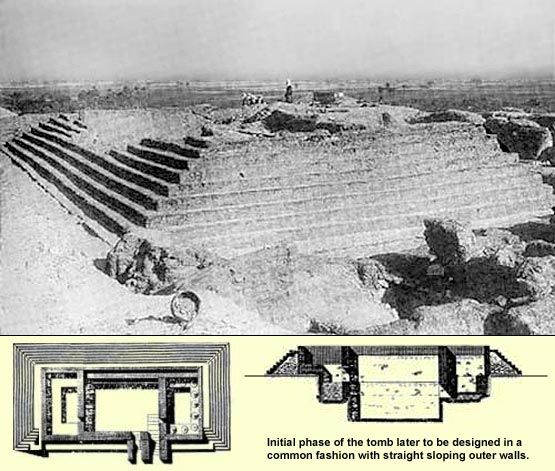
Mastaba 3038 showing the original construction phase. Image Credit Nemo.nu

It’s no coincidence that barely 200 years later, an architect named Imhotep designed one of the most iconic funerary monuments in Egypt at the same site, inspired perhaps by mastaba 3038.

The Step Pyramid (c. 2670-2650BC)

The name Imhotep may sound familiar for those that have seen the brilliant, if slightly inaccurate, The Mummy and The Mummy Returns films. In actuality, Imhotep was not a high priest, but a gifted architect responsible for the earliest pyramid in Egypt. The Step Pyramid at Saqqara, just like the mastaba tombs of the Early Dynastic period, took the existing designs of funerary architecture one step further.
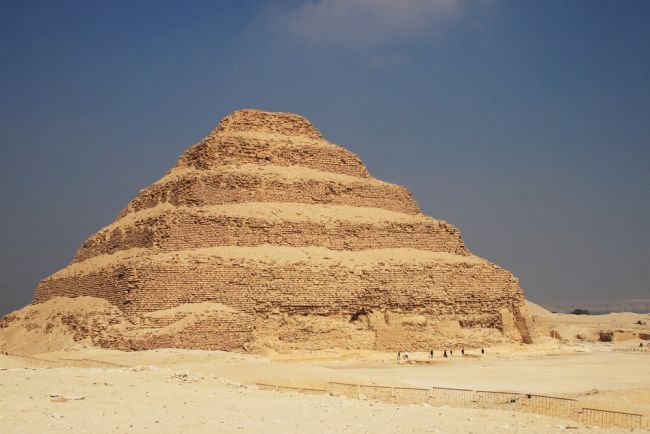
The first pyramid in Egypt. Image Credit: Live Science

Constructed as the burial place for the 3rd Dynasty Pharaoh Djoser, the Step Pyramid was built with six steps, forming the centre piece to an impressive mortuary complex. The pyramid was constructed in six stages, beginning with what appeared to be a square shaped mastaba, before later being extended into a more rectangular shape. This would suggest this was an experimental design. This was also the first large scale masonry monument, with much of the rock argued to have come from the construction of the great trench which formed part of the complex.

The Old Kingdom is also known as the ‘The Pyramid Age’, for obvious reasons. It began with Djoser and the construction of the Step Pyramid, but tradition suggests the Egyptians weren’t finished just yet. They wanted to perfect their design.

Rise of the True Pyramid (c. 2613-2590BC)

Why the Pyramid?

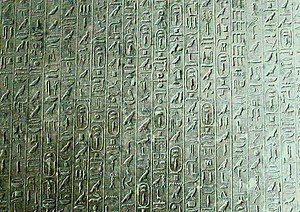
The Old Kingdom is not just known for the pyramids, but for the rise of hieroglyphics. The Pyramid Texts are currently the oldest known body of Egyptian religious texts, first appearing at Saqqara towards the end of the Fifth Dynasty. They contain one of the earliest creation myths in history, the story of the primeval mound.

According to the myth, the world as we know it rose from the chaotic waters (personified as the goddess Nu). The first thing to appear from the waters was the primeval mound, represented as the benben. The original benben was said to be located at Heliopolis, representing where the first rays of sunlight hit the earth. This stone formed a pyramidal shape and replicas were used to top the pyramids of the Old Kingdom. This myth, like many of the religious beliefs of ancient Egypt, found its’ origins in the natural world.

Think about it like this, ancient Egypt existed because of the Nile. After the annual flood the water would recede, leaving behind the floodplains perfect for cultivation. The imagery of the primeval mound could very easily represent the moment new land appeared from the retreating water.

To put it another way, while at the beach, if you ask a child to make the biggest structure they can, chances are a mound will slowly appear before your eyes; largest at the bottom rising to a peak at the top. What would happen if you optimised that mound, emphasising the peak as a single point? You would be looking at a pyramid.

Put simply, the Egyptian pyramid represented the perfection of nature. It was the ultimate symbol of life, constructed as the ultimate embodiment of death.

Sneferu’s Three Pyramids

Sneferu was a pharaoh of the Fourth Dynasty. Given his building projects at the Dashur pyramid site, it’s a wonderful coincidence that his name translates to “he has perfected me”. If there was one who personified trial and error, it would be Sneferu and his lifelong obsession for pyramidal perfection.

The Meidum Pyramid: A Failed Experiment? (c. 2613BC)
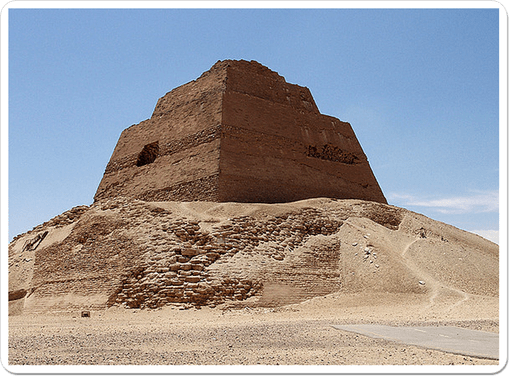
The collapsed Meidum Pyramid. Image Credit: Jacques Kinnaer

When Sneferu started his first building project, he set out with one clear goal in mind, to create the first true pyramid. His logic for achieving this was undeniable; the current step pyramid design could be improved by simply filling in the steps with limestone to create a smooth side. However, the steps themselves were not flat, thus creating instability when using it as a platform to create the smooth surface. Despite an uncertainty by archaeologists as to when, one thing is clear, the pyramid collapsed. The remains today show only part of the original stepped structure.

Sneferu would have to think again. It was time to take the next step.

The Bent Pyramid (c. 2600BC)
The odd looking Bent Pyramid at Dashur. Image Credit: Ancient-Egypt.co.uk

To create a true pyramid, the step pyramid design would have to be abandoned. Sneferu’s second building project at Dashur was the first attempt using this new construction method. The result is what has become known as the Bent Pyramid, for obvious reasons. Initially, the pyramid was planned with a 54 degree angle, but for reasons archaeologists cannot agree on, this was changed to 43 degrees near the top. If we assume the collapse of the Meidum pyramid had already taken place, the angle change may have been a safeguard. The engineers may have noticed similar instability, therefore deciding on a shallower angle to prevent collapse.

Sneferu was close now. Could he make it third time lucky?

The Red Pyramid (c. 2590BC)
The first true pyramid in Egypt. Image Credit: Destination 360

Named for its’ reddish hue of the limestone blocks, the Red Pyramid represents a turning point in Egyptian funerary architecture. It is the first true pyramid of the Old Kingdom. The construction of the top of the Bent Pyramid showed the success of the 43 degree angle, so why not start with a 43 degree angle? The result is the third largest pyramid in Egypt.

Over a truly impressive period of only approximately 30 years, Sneferu finally achieved his true pyramid. But it would be his son who took the final step and achieved the ultimate dream; the perfect pyramid.

The Great Pyramid of Giza (c. 2560BC)

When Khufu took the Egyptian throne, the design of the true pyramid had been perfected by his father Sneferu, or so he thought. Khufu had other ideas. Gazing at the impressive Red Pyramid, something didn’t seem right. The pyramid looked a little, squat. The 43 degree angle was chosen after the compromised Bent Pyramid. 43 degrees worked, 43 degrees was safe. But to achieve greatness, you have to push the boundaries. When Khufu selected Giza as his new pyramid site, that is exactly what he did.

The Bent Pyramid became unstable at a 54 degree slope, but things had moved on since then. The question was, how far could you push the angle while retaining structural stability? The answer was 51.5 degrees.
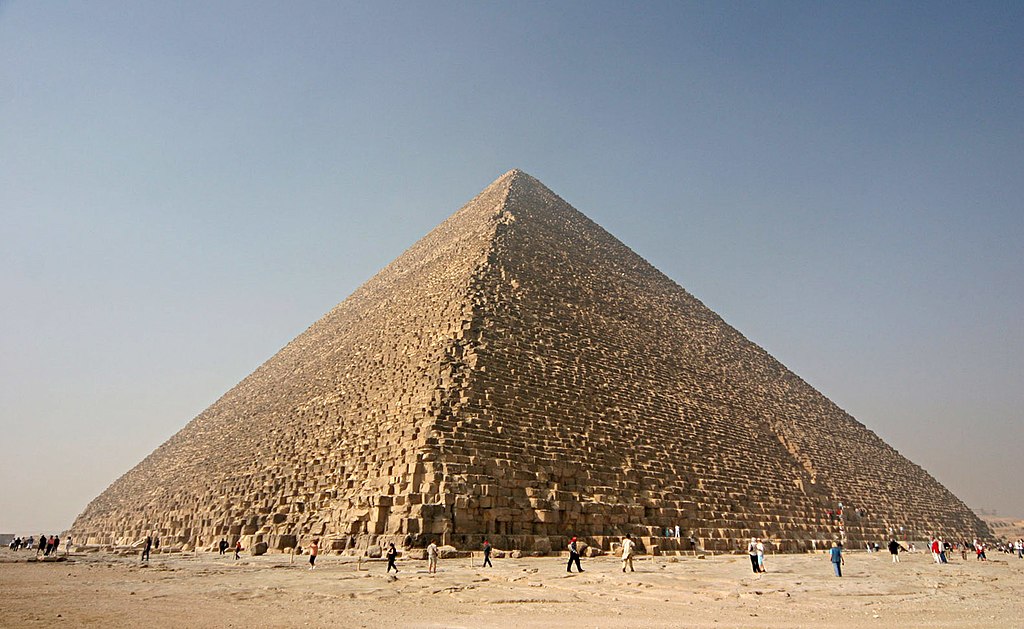
The realisation of a dream, thousands of years in the making. Image Credit: Nina Aldin Thune

Towering above the desert at a height of 481ft (when originally completed), with a base of 756ft and a volume of 91,227,778 cubic feet, Khufu’s pyramid became the definition of monumental architecture. It’s been theorised the project took approximately 20 years to complete, using 2.3 million blocks of granite and limestone. When finished, the pyramid would have stood alone in the landscape, shining with its white limestone casing. It’s no wonder it became one of the Seven Wonders of the Ancient World. It took 3,800 years for the Great Pyramid to lose the title of tallest human-made structure in the world, losing to Lincoln Cathedral in 1311.

The other royal pyramids at Giza display three interesting features: they all follow the same design as Khufu, they are not as big and all sit in the shadow of their predecessor. If you follow the sight line from Menkaure’s pyramid through Khafre’s and Khufu’s, you will reach Heliopolis (the location of the original benben stone).
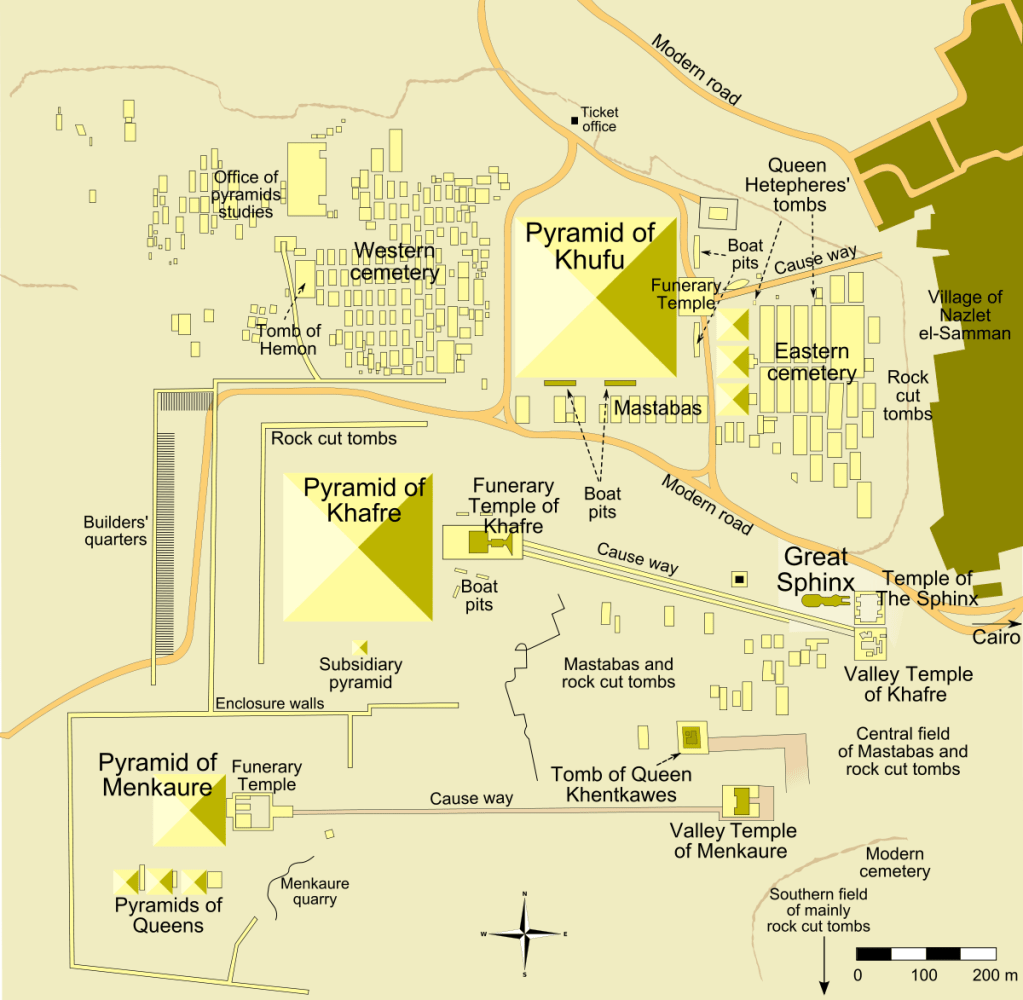
The Giza pyramid complex

Understanding the complexities of the Great Pyramid would take a lifetime, including areas such as the use of contractor work forces, the workers’ town and of course the method of construction, but the end product proves one thing. To achieve such a building project would require immense economic power, further proof of the success of the Egyptian state of the Old Kingdom. The Giza pyramid complex personified the political, economic and religious power of the Egyptian kingdom.

The end of the Old Kingdom also marked the conclusion of grand pyramid projects; Egypt was thrown into turmoil following a famine and the breakdown of the political leadership.

A Celebration of Human Achievement

The popularity of alternative archaeology has given rise to a desire to discredit our past. Despite the achievements humanity makes every year, it seems somehow unfathomable to imagine such achievements were possible in the ancient past. The question is, why? The story of human society is a never ending narrative, one which needs a past. Without it, much of what we enjoy today wouldn’t exist. Perhaps it’s because we have struggled to recreate some ancient technology, but our brains convince us if we can’t do it, the people of the past definitely couldn’t. This, by the way, is ridiculous. I can’t do rocket science, but given the multitude of human objects in space, clearly others can.

The Great Pyramid of Giza is a celebration of human achievement. Taken in isolation, it would be hard to explain. But very little exists in isolation. Starting with the Predynastic pit burials, to the mastaba tombs of the Early Dynastic and the Step Pyramid of Djoser, these developments existed in parallel with the flourishing of the Egyptian state. Successive kings wanted to acknowledge the funerary architecture of their past, while also pushing the boundaries of what was possible, creating something new and expressing their power as ruler. The triad of pyramids by Sneferu is proof this didn’t always work.

By following these creations over the generations, the Great Pyramid is constructed in front of your eyes. At the height of the Old Kingdom, the Egyptian state had risen to become one of the most powerful in the world, characterised by a pyramid that stood above all else for 3,800 years. This was a symbol life, the embodiment of death and the perfection of the natural world existing in a single monument paying the ultimate tribute to all that had come before.

So no, it wasn’t aliens. But the real story is much more fascinating, with many questions still to be answered. The Giza pyramids represent a cultural and architectural evolutionary end-point thousands of years in the making. They were the dramatic final act in one of the greatest stories ever told.

Jurassic Park: Could Life Find A Way?

When Jurassic Park was released in 1993, it captured the imagination of the entire planet. Audiences saw dinosaurs resurrected on-screen, not just through the magic of cinema, but through seemingly believable biological engineering. After nearly 27 years, part of me still clings to the hope of turning the film into a reality. Could dinosaurs be brought back to life? Could life, uh, find a way?

Dinosaurs have never been strangers to the big screen. Don’t forget, the T-Rex had taken on King Kong back in 1933, Disney made their first dinosaur film, Fantasia, in 1940 and of course The Land Before Time had moved audiences to tears in 1988. These films had existed solely in the fantasy realm, but when Jurassic Park was released in 1993 (based of course on the sensational novel by Michael Crichton), everything changed. It thrust dinosaurs into a whole new world. On top of that, it had everything you need in a film: action, suspense, comedy, and a T-Rex eating a man on the toilet. Obviously.

As a child, Jurassic Park was always one of my favourites, and I’d be lying if I said that wasn’t still the case today. Unlike other dinosaur films, this exists within the real world which instantly makes it more relatable. Using biotech engineering, humans recreate dinosaurs for a theme park. The film explores the evolving relationships between humans and these dinosaurs, when inevitably control begins to break down. But its the science that always fascinated me.

But you don’t want to hear about that from me. I’ll hand this over to Mr DNA himself to explain the science behind the Jurassic Park dinosaurs:

Video credit: Universal Pictures, all rights reserved.

The science of Jurassic Park appeared to make so much sense, so why are we still living in a world without dinosaurs? Surely we have the knowledge and technology to bring dinosaurs back today, right?

It was clear from the start I’d set myself up for disappointment.

The Process: Creating Dinosaurs

Theoretically speaking, the science of Jurassic Park checks out. Sadly though, last time I checked there is a significant difference between theory and practice. If we break down what Mr DNA says, it doesn’t take us long to highlight some fundamental problems with their process. Let me explain.

  • The Mosquito in the Amber – What if the mosquito has bitten multiple animals before landing in the tree? Those scientists could be dealing with Double-Dino-DNA at the very least.
  • Recreating the Genetic Structure – Dinosaurs have been extinct for 65 million years, yes? Humans are yet to make their first million. Our species have never seen a dinosaur before, so how would we know when we got it right? How can you recreate something when you haven’t seen it before. Through trial and error, there is a faint possibility dinosaurs could be created, but again, how would we know? If our mosquito friend had bitten three dinosaurs, would we realise when we had created a new hybrid dinosaur from the blood? How could the DNA be separated, when we don’t have a genetic model for a dinosaur in the first place? But more on that later.
  • Sequence Gaps – What happens when the genetic material of a lion and a tiger are combined? You get a Liger. The moment you add DNA from frogs to complete the sequence gaps of a dinosaur, you no longer have a dinosaur. Does that mean those scientists created frogasaurs?

Discovering Dino-DNA

The theory presented in Jurassic Park hinges around extracting dinosaur DNA. Discovering dinosaur DNA is probably the ultimate goal for any palaeontologist. If genetic information could be extracted from fossilised remains and studied, it would open up a whole new frontier. Alas, it just doesn’t appear to be within the realms of possibility.

We would need intact DNA strands to be able to piece back together. However, research has now suggested DNA has a half-life of approximately 521 years in bone, meaning therefore after 6.8 million years all the links within the structure would have been destroyed. Simple subtraction tells us a 58.2 million year gap is rather difficult to ignore. Extracting dinosaur DNA may be something that just isn’t possible.

This theory has been challenged by the discovery of possible DNA-staining in the fossil of a baby hadrosaur called Hypacrosaurus. However, these traces have not been confirmed as the real thing. If confirmed, these traces would be degraded remnants of genes that cannot be read. They are the broken-down components rather than intact strands.

I don’t think life will be finding a way any time soon. But what if there was another way?

De-Evolution Towards Dinosaurs?

One of the principal advisors used on Jurassic Park was Jack Horner, a well-known palaeontologist, who also served as the inspiration for the character of Dr Alan Grant. He believes the secret to engineering a dinosaur lies in the most unlikely creature imaginable, a chicken.

It is a commonly held understanding that modern day dino-descendants are birds. Research has suggested chickens, existing in the same genetic family tree, may have the most similar DNA to that of the dinosaurs. Clearly, chickens have had some time to evolve. Wait, if chickens can evolve, what’s to say they can be de-evolved? Could we reverse engineer a chicken to unleash it’s inner dinosaur?

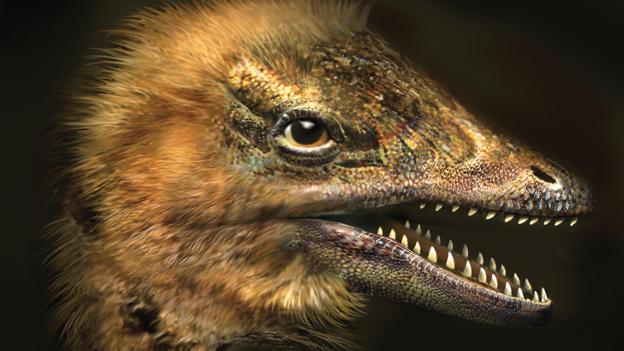
This is precisely what Jack Horner wants to do. In a study from 2015, a chicken embryo was created with what appeared to be a dinosaur-like snout. By examining beak structures in the embryos of chickens and emus, along with snouts in alligator, turtle and lizard embryos, the researchers were able to reverse engineer the chicken beak. Birds have a unique cluster of genes relating to facial development which non-beaked animals lack. By tracking the genetic evolutionary footprint, certain genes were silenced to reveal the original ancestral form of the beak.

De-Evolution in action. Image Credit: Stocktrek Images, Inc. / Alamy

Further research has been done by geneticists at the University of Chile, focusing on the anatomy of the leg and foot, with promising results including a full-length fibula reaching the ankle.

The end goal is to create what Jack Horner refers to as the ‘chickenosaurus’, which he sees as a possibility, but realises there are huge hurdles to overcome. Evolutionary biology may in fact hold the key to the lock the fictional scientists in Jurassic Park were trying to open.

Rambunctious Reptiles or Feathered Fiends?

The traditional concept of a dinosaur was based in the reptilian realm; scales were the skin of choice. Despite a nod to the link to modern day birds, Jurassic Park retained the conventional lizard-like appearance of the dinosaurs.

The link to modern day birds extends to the possibility that dinosaurs may not have been as naked as tradition suggests. Fossilised bones show evidence not only for air sacks and hollows, but for the existence of feathers. Recent publications therefore suggest a radically different look to the ‘vicious-lizards’ than originally thought.

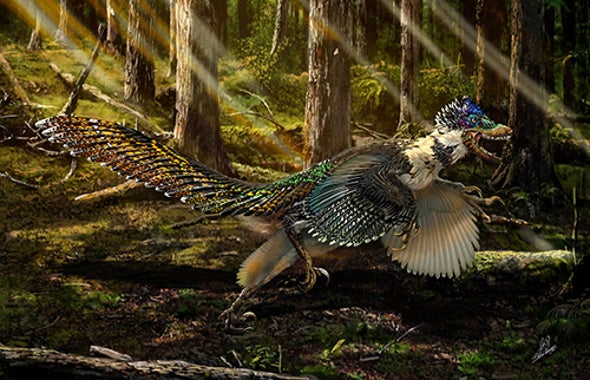
The new look feathered Velociraptor. Image Credit: Zhao Chuang / Scientific American

Using the Velociraptor for my feathered image was intentional, for it illustrates the other (fossilised) bone of contention. The appearance of the dinosaurs in the Jurassic Park series required a large amount of artistic license to be believable. The on-screen Velociraptors were actually modelled on Deinonychus, Utahraptor or Achillobator. Remains of real Velociraptors tell us they were in fact barely 2ft tall.

The Jurassic Park series does at least cleverly address the question of dinosaur realism:

What is left of them is fossilised in the rocks, and it is in the rock that real scientists make real discoveries! What John Hammond and InGen did at Jurassic Park is create genetically engineered theme park monsters! Nothing more and nothing less.

Dr Alan Grant. Jurassic Park III

Nothing in Jurassic World is natural! We have always filled gaps in the genome with the DNA of other animals. And if the genetic code was pure, many of them would look quite different. But you didn’t ask for reality, you asked for more teeth.

Dr Henry Wu. Jurassic World

Genetic engineering will never replace the realism of the dinosaurs. Perhaps the criticism was justified after all. The Jurassic Park scientists may have made dinosaurs, but given their process of biological engineering, can they be called dinosaurs at all?

Could Dinosaurs Survive Today?

Let’s pretend for just a minute we cracked the code of creation and dinosaurs were brought back to life. Yes, engineering these animals is one achievement, but that’s in no way the whole story. Our journey through life is not complete at creation. There is still the small matter of survival. Would a real life Jurassic Park be viable? Could these animals survive in today’s environment?

Straight off the bat, there is a slight issue surrounding nomenclature. If you look at the dinosaurs that made up the original park, it won’t take long to notice the majority came from the Cretaceous period. Thinking about it though, ‘Cretaceous Park’ doesn’t have the same ring to it. After all, we’ve already proven the dinosaurs weren’t accurate, so why should the name be, right?

Facetiousness aside for a minute, survival presents us with yet more problems, one of which is the climate. Throughout the Cretaceous period, global temperatures were around 4 degrees warmer than today, with four times the amount of carbon dioxide in the atmosphere. The dinosaurs lived in a constantly warming world with more consistent temperatures between the poles. The oceans too could reach temperatures up to 42 degrees, 14 degrees higher than even the warmest waters today.

Increased levels of carbon dioxide was not the only atmospheric difference. In school, we are taught there is around 21% oxygen in the air we breathe. If we reversed the clock 65 million years, that figure would have been much different. There are many that believe oxygen peaked at around 30% during the Cretaceous. It would explain how dinosaurs grew so much larger than even the mega-fauna of today. Recent studies with amber have however challenged this assertion, claiming the dinosaurs actually lived in a low-oxygen environment. If this is true, further studies would need to be undertaken into the colossal size of these animals.

One thing can be said for certain, the atmospheric composition was vastly different to today. Many of the dinosaurs would struggle to breathe properly. If the oxygen was as high as traditional studies suggest, existing today would be the same as us trying to do exercise on the top of Mount Everest, a little on the breathless side. Hardly ideal for survival if you ask me. Their biology evolved to survive in their climate, not a climate from the future.

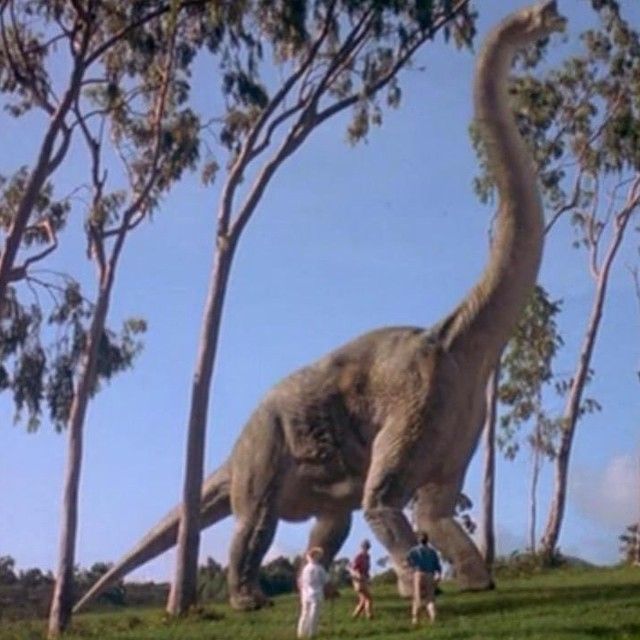
And we thought elephants and giraffes were large!

Finally, there is the question of habitats. There are pockets of land around the world which would be similar to that of the Cretaceous, such as humid wetlands or deserts. But the plains that saw the rise of animals like the Triceratops and Diplodocus do not have parallels; we have grass where they had ferns and primitive shrubbery. Imagine the sheer size of the land required to house (and feed) creatures like the gigantic sauropods. Don’t forget humanity’s love for expansion at any cost; when we can barely manage our own wildlife, should we really introduce dinosaurs into the mix?

The Important Question

I set out to find whether it would be possible to bring dinosaurs back to life. Despite my childlike hopes, however believable the science is, Jurassic Park is nothing more than a fantasy, masquerading itself in the real world. It did however serve as inspiration; perhaps there was another way, such as the idea of reverse engineering. There may be a few weird-looking chickens along the way, but we might just make some exciting leaps forward.

The question, however, is what would we create? We have no blueprint. We just have the world’s most difficult jigsaw with no guiding picture and an almost infinite number of pieces. The ‘reality’ of dinosaurs is an ever-changing picture; we have moved on from vicious lizards to creatures covered in feathers after all. Palaeontology exists to challenge the accepted view to further our knowledge, so the goalposts are forever on the move. Would we stay true to reality, even if we knew the reality? Could we resist abusing their existence in the pursuit of profit?

Genetic power is the most awesome force the planet’s ever seen, but you wield it like a kid that’s found his dad’s gun. You stood on the shoulders of geniuses to accomplish something as fast as you could, and before you even knew what you had, you patented it, and packaged it, and slapped it on a plastic lunchbox, and now you’re selling it. You want to sell it.

Ian Malcolm. Jurassic Park.

Even if we could bring dinosaurs back, what world would they be living in? What further changes would need to be made for them to survive in the 21st Century? What would become of the failed experiments? What life would they lead?

I started this by asking whether life could find a way. Perhaps I’ve been asking the wrong question. The question should never have been ‘how’. There are some things that are simply more important:

Your scientists were so preoccupied with whether or not they could that they didn’t stop to think if they should.

Ian Malcolm. Jurassic Park

(Re)Starting Something New

Every destination needs a journey. Every journey needs a beginning. And every beginning needs those very first steps. Starting something new is never easy. But what if, this time, you’re starting again?

It’s funny isn’t it? For as long as I can remember, I’ve spoken of this moment. I could spend hours outlining the details of my plan to anyone that would dare to ask. As time passed by, I convinced myself that would be enough. It was forever on the horizon; nothing more than a tantalising glimpse into a future I knew would never come to pass. But despite everything, and despite myself, we find ourselves at the start of something new. And yet, in the face of my vision finally forming a reality, those very same words that once ignited the spark of an idea, have simply, abandoned me.

In a not too distant past, words were my greatest asset. At the apex of my abilities, I made what many might call a living from harnessing their power. Over time however, events would come to overtake me, diminishing my output. Eventually, the writing became nothing more than a conversation topic and a hope for very few followup questions. I promised myself it wouldn’t be the end and this project wouldn’t be a lie. Starting something new is never easy. But how was I meant to start again?

Why The Osiris Diaries?

I could simply say the name is a celebration of my passion for Egypt’s ancient past. And that would be the easy answer. But the truth is more complex.

Throughout my studies of the Egyptian past, I focused on story telling through the influence of the natural world. Their world order, like almost any civilisation, was built around their environment. Against all the odds, they brought life to the desert, flourishing into something timeless. Spanning thousands of years, the people of ancient Egypt translated their experiences into a cultural narrative, manifesting in the mythology that lives on today in our global consciousness. They embraced who they were and remembered where they came from.

The Osiris Myth was first recorded in the Pyramid Texts from 2400BC. Times and people change, but 4,500 years later, the story lives on in our collective consciousness

Of these stories, the Osiris myth survived the ages, becoming one of the most influential stories of the Egyptian past. From the early years of the Egyptian kingdom until the days of the classical Graeco-Roman writers, this story united people in the belief that anyone could reach the afterlife. Even after the fall of the Egyptian religion, the story of Osiris survived as one of the major western impressions of ancient Egypt; a story so potent it has survived for nearly 4,500 years.

Egyptian Creation: Osiris, Isis and Horus

At the beginning of time there was Geb, god of the sky, and Nut, goddess of the earth. Together they had four children, Osiris, Isis, Set and Nepthys. As the oldest, Osiris became the king of Egypt, marrying his sister Isis. He ruled with absolute surety over the people on earth, while commanding respect from the gods.

Set, fuelled by jealousy and a lust for greater power, transformed himself into a monster and murdered Osiris. His body was cut into pieces and spread across the land of Egypt. Set, taking his sister Nepthys as his queen, claimed the empty throne, and with it, the Egyptian crown.

Overcome with grief over the death of her husband, Isis decided to use her magical powers to resurrect Osiris just long enough for them to have a child. Together with her sister Nepthys, Isis located each part of the body and breathed new life into her husband. Together again, Isis soon became pregnant and gave birth to a son, Horus. Osiris soon was able to descend into the underworld, ruling for eternity as the lord of that land.

Upon reaching adulthood, Horus would come to challenge his uncle for the throne, to take his place as the rightful king. Competing against each other, Set used underhand tactics to break Horus, however the contest would end in a draw, with the gods uncertain of who deserved the crown.

As the last great king of Egypt, the gods consulted with Osiris in the underworld, who declared that his son is the only rightful heir to the throne, arguing that no one should take the throne through murder. Using his great allies of the sun and stars, Osiris descended the world into darkness before finally, the gods announced Horus would claim his birthright and take his position as king of Egypt.

The universal appeal of the story exists from it’s basic elements of humanity: love, family, and respect, alongside jealousy, betrayal and a lust for power. Through the major theme of order vs disorder, in itself an integral part of Egyptian thought, it creates the timeless story of good vs evil. The resulting conflict ends with the restoration of Maat, translated roughly to mean cosmic and social order. The battle between order and chaos, light and dark, or good and evil to restore balance forms the foundations to some of the greatest stories ever told. It’s no wonder that one of the oldest stories on earth contains hauntingly familiar elements to the narratives of storytellers from across history, including our contemporary world.
For the Egyptians, the Osiris myth formed the basis of their religion, while paying tribute to their own origins; it was the regional conflict in their early history that gave rise to the kingdom of ancient Egypt. It’s the combination of foundations and futures that drew me to Osiris. Progress, change and development require a respect of your own origins; you need to know who you are.

It was the hieroglyphic form of his name that inspired the logo for The Osiris Diaries. The eye in Egypt had connotations of Horus, as well as the sun god Ra, representing protection, power and health. The use of the eye in hieroglyphics (ir.t) translates as ‘to make/do’ or ‘one who does’. So to answer my original question, the story of Osiris reflects what I want for my own writing. Despite the darkness, Osiris was resurrected, bringing together the individual parts to form the whole. Everything has come together and serves as both an identity and my inspiration.

(Re)Starting the Journey

Overcoming the invented limitations of my own mind has been neither simple, nor easy. Reaching what is the concluding section of this inaugural entry is a milestone I truly believed was one step beyond my own capabilities. To pick up where I left off has been a daunting experience, but one that has ignited that same spark of excitement I remember so vividly from what feels like a lifetime ago.

Just like Isis herself, I wish to bring together each element of myself to form the one; to form The Osiris Diaries. Despite the seemingly unconnected subjects of my writing, there is a universal commonality that bonds them together. Whatever the substance, my words will focus around the two great powers of our world. The human experience exists through stories; people are defined by their own stories. The stories we choose to tell form the foundations for our future.

It took me a while, but I’m finally here. I fought through the darkness and found something wonderful. There may be a long road ahead, but the spark survived. For now, all I can say is welcome.

Welcome to The Osiris Diaries.